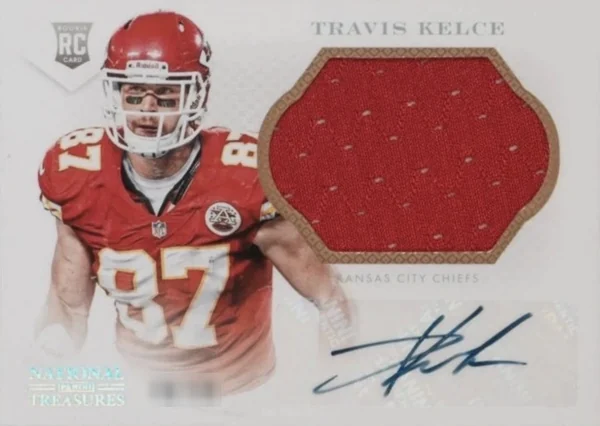
The letters stand for Rookie Patch Autograph, and they describe a recipe more than a card: a first-year player, a piece of cloth set into the front, his signature over the surface, all three on one serial-numbered object. National Treasures had made cards to that recipe since 2006, under the Donruss Playoff name until Panini bought the company in 2009, and the 2013 checklist ran in tiers. Cards 151 through 200 were the rookies plain. Cards 201 through 240 were the 40 who had attended the players’ association Rookie Premiere in Pasadena, California, on May 18, 2013, where the jerseys and signatures were gathered. A second run, 241 through 340, took the rookies the Premiere had not invited.
Travis Kelce is number 334. He was the 63rd pick that April, the fifth tight end taken, behind Tyler Eifert at 21, Zach Ertz at 35, Gavin Escobar at 47 and Vance McDonald at 55, and all four were in Pasadena, as was Jordan Reed, taken 85th. Five tight ends in a room of 40 is a great many for a position the card companies treat as an afterthought. Kelce was not among them. His card sits in the second run, issued two ways under one number: a signature alone, and, for 26 of those players, a signature with a jersey piece, each to 99. The second is his RPA. The checklist does not say where the cloth came from.
Five tight ends in a room of 40, and the fifth tight end taken was not one of them.
The product reached shops on March 26, 2014, by which time his rookie year was over and had amounted to one snap: Week 2 against Dallas, on the field-goal unit, asking the man beside him to take the block because the knee was already wrong. Surgery followed, the microfracture kind, and injured reserve on October 12, 2013. The card carries a signature from before any of that, and it arrived when the most anyone could say of him was that he was rehabilitating, long before the postseason catches that carried him past Jerry Rice.
Why this one, when 2013 also gave him a Contenders Rookie Ticket, number 187? A tight end rarely carries a rookie class, and Kelce did not carry this one; he was a third-round name in the second run. The RPA is the fullest version of him the year produced, the hand, the cloth and the number on one card. The rest is fashion: National Treasures became the hobby’s word for a rookie’s most elaborate card sometime after this set.
The object is the difficulty. A National Treasures card is five to seven layers of paper, foil and window glued into a slab about 130 points thick, and a corner on it is a cube with three exposed faces; the die that cut it can lift the top layer before the card has left the factory. The glue ages, and the cloth is held in by the same glue as everything else. The signature is judged on its own, by a second grade on the same label, so the card can be right and the ink wrong, or the reverse.
It is a heavy card for a light year. The ink, the cloth and the 99 were fixed in place before he had played a down, and nothing on it has changed since.