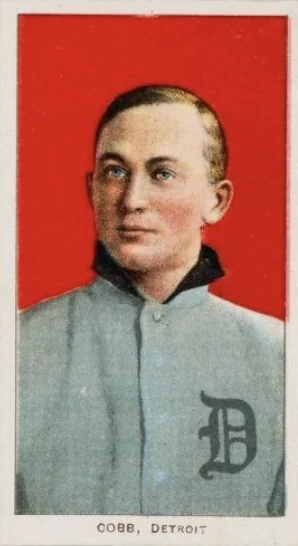
The T206 set is where the hobby begins. Five hundred-odd subjects issued across three years, printed on thin stock and slipped into cigarette packs as stiffeners — a piece of cardboard whose original job was to keep the tobacco from crushing. They measure an inch and seven-sixteenths across. Nearly everything about how they were made and where they were kept argues against their survival, which is the whole reason a clean one is remarkable.
Cobb appears four times in the set, and collectors treat the four as four different cards, because they are: two portraits and two poses with a bat, each with its own population, its own demand and its own price. This is the Red Portrait — his face against a flat red field, the most recognizable of the four and the one people mean when they say a T206 Cobb without saying which.
A piece of cardboard whose original job was to keep the tobacco from crushing.
The condition problem is total. These came out of cigarette packs, so they carry tobacco staining and the smell of it a century later. They were carried in pockets, tacked to walls, and traded by children who had no reason to imagine anyone would care. The stock is thin enough that a corner touch shows immediately, and the printing of the era left its own soft edges. A T206 grading in the middle of the scale is not a compromised card — it is a card that came through.
As for the man, the record is uncomfortable and it is also unambiguous. He hit .366 across twenty-four seasons, a career average nobody has approached since, and when the Hall of Fame elected its first class in 1936 he received more votes than Babe Ruth. He was, by wide report, difficult and worse. The card does not adjudicate any of that. It sits at the head of the hobby because the hobby began with this set, and because for a long stretch of American life his was the name a boy said first.