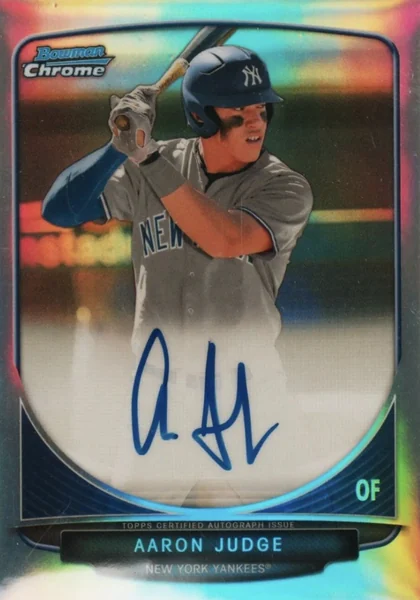
The name on the box was not quite the name the hobby uses. In 2013 Topps did not sell a separate Bowman Chrome Draft; it sold Bowman Draft Picks & Prospects, a paper product that arrived in the last weeks of the year with the draft class inside it, and the chrome came in the same packs. Every hobby box carried one Chrome Draft Pick Autograph, from a set of 47 signers drawn only from the first three rounds of that June’s draft. Aaron Judge, taken 32nd by the Yankees, is BCA-AJ. Collectors say “2013 Bowman Chrome Draft” and everyone knows what is meant, but the card came out of a paper box.
It is signed on the card. The chrome went to the player printed and came back with ink on it, so the signature sits on the mirrored surface itself rather than on a sticker laid down afterward. These were the first cards to show the class in the uniforms of the teams that had taken them, which is why it carries the interlocking NY and not Fresno State. Above the plain version run the Refractors: unnumbered, then Blue at 99, Green at 75, Gold at 50, Black at 35, Orange at 25, Red at 5, two Wave patterns at 50 each, and a Superfractor of one.
The signature sits on the mirrored surface itself, not on a sticker laid down afterward.
A prospect card is a matter of a logo. Since 2006, under the players’ association rules, a card may carry the rookie designation only once the player has been on a big-league club, and Bowman’s draft and prospect cards are formally inserts, numbered on a separate track, without it. Judge’s cards with the logo came in 2017, the year he hit 52 home runs. By then this one was four years old. The hobby treats it as his first because it is: the earliest card of him signed under a Topps license, in a Yankees uniform, printed when the only things known about him were a draft slot and a height.
That was the summer of 2013. He was a college outfielder from Linden, California, taken with a pick the Yankees held as compensation for losing Nick Swisher, and he signed for $1.8 million. A torn quadriceps kept him off every field that year, so the card was in packs before a box score anywhere carried his name. Two years after his first minor-league game he homered in each of his first two big-league games, and the card, unchanged, was the first object in a long story.
Two things are graded on it, and neither forgives. The card is chrome, a picture under a clear layer bonded to a reflective sheet, and the two layers answer humidity differently, which is why these cards bow and why a flat one is uncommon enough to notice. Print lines run through the mirror where the press dragged, and a hairline scratch shows as a bright thread. The autograph gets its own mark: a pen that skipped on the slick surface, a stroke that ran off the edge, ink thin because chrome does not absorb it. The good ones are the ones where his hand and the printer were both steady on the same afternoon, and nothing since has been able to improve either.