What cards does my family need to know about?
The problem is not value. It is memory.
A serious collection is usually understood by exactly one person. Which card is the good one. Which is worth more than it looks. Which was bought the week a first child was born, and should never be sold whatever it is worth.
None of that is written anywhere. And when it is needed — and it is always needed at the worst possible moment — the people who need it are the least equipped to work it out. What tends to happen next is that a family accepts the first offer from the first dealer through the door, because they have no way to know whether it is a fair one.
A written record does not prevent that by being clever. It prevents it by existing.
What we make
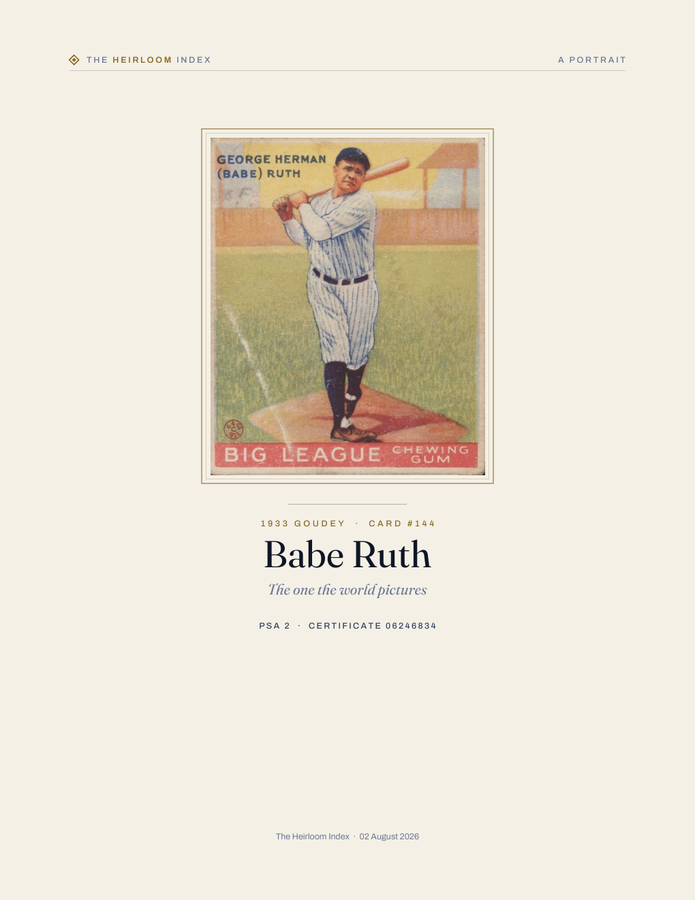
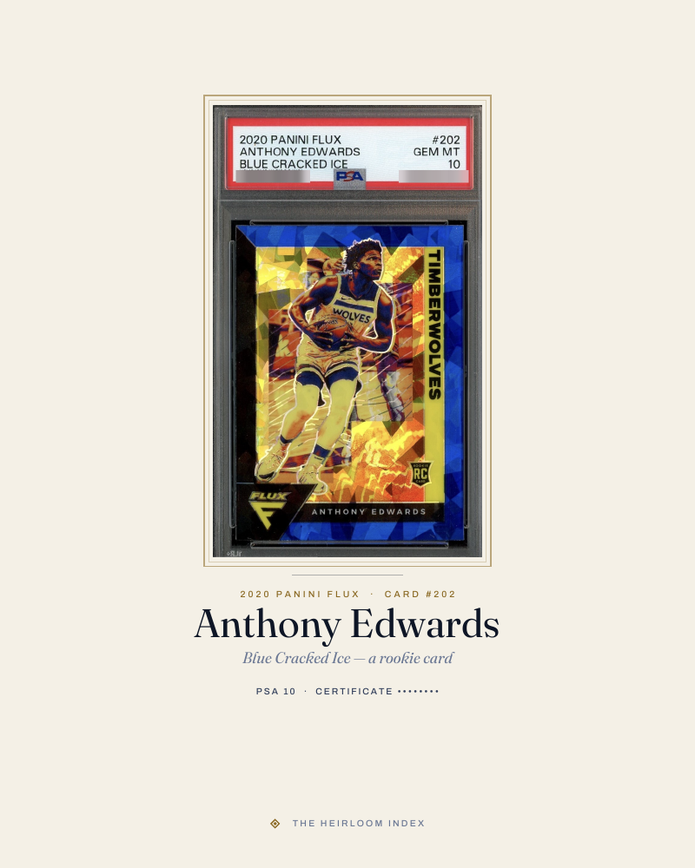
The Documentation Kit is the instruments themselves, to fill in by hand. The three below it we write for you. A Portrait is one card of real significance, documented — the story, the grade, and what the public record shows it has traded for, printed to be framed. A First Card is a keepsake: the card someone was given, or pulled from a pack, or bought at a show — and the memory around it, with pages left blank for the part only your family can write. A Record is a ledger — the whole collection, written to be filed.
- The Documentation KitThe same instruments, without us doing the writing. The register, a record sheet for each card, the Heirloom Letter, the photograph guide, the contact sheet and the certificate log — six documents, fifty-three pages, delivered as a PDF to fill in by hand. How it works →$75you do the writing
- The First CardThe one that started it — a child’s first real card, or the one you pulled from a pack and never quite put away. What the set is, what the parallel is, what the grade means, and then pages left deliberately blank: how it came to be theirs, who gave it, and room to write in their own hand. There is no price anywhere in it, on purpose. See a finished one and order →$145for any card
- The PortraitOne card, documented in full: the story of the player and the set, the grade register, and the verified record of what it has traded for at public auction. Printed on archival stock and ready to frame. A child’s first card is made differently — there is a finished example below. See a finished one →$299or three for $750
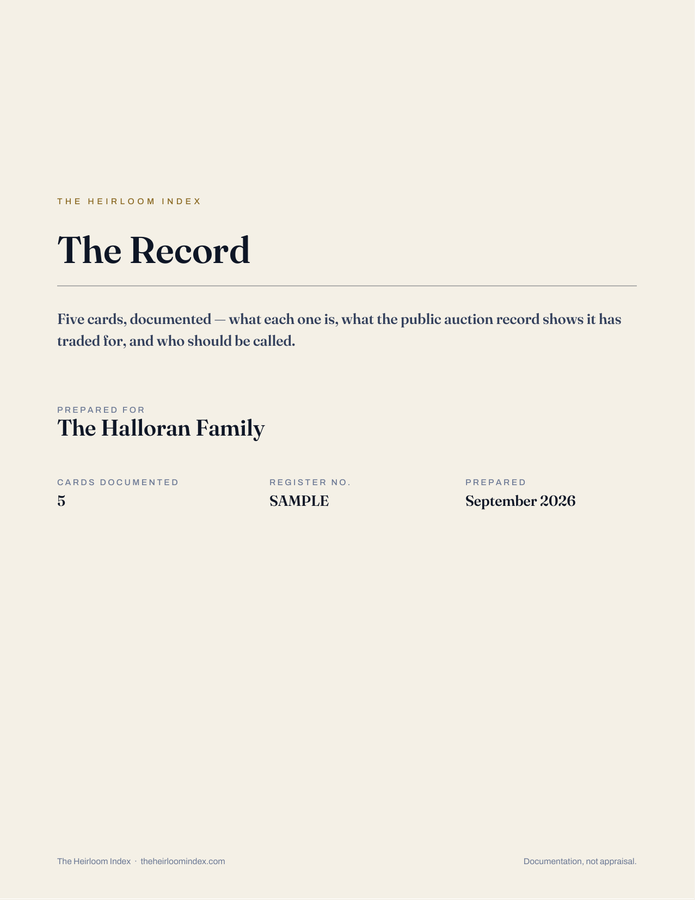
- The RecordAn entire collection, in one document. What you own, where each piece is, what grade it carries, what the market has paid for it, and who your family should call. Priced by how many cards you document, and refreshed once a year so it does not go stale in a drawer. See a finished one →from $950see the table below
| The Record | To write it | Each year after |
|---|---|---|
| Up to 5 cards | $950 | $125 a year |
| Up to 12 cards | $1,950 | $195 a year |
| Up to 25 cards | $3,500 | $295 a year |
More than twenty-five cards is a larger piece of work than we can promise to turn around well right now, so we have not priced it. Ask, and we will tell you honestly when we can take it on.
A rough guide, not a rule: a Record earns its keep on cards worth about a thousand dollars or more. Below that you are spending a meaningful share of the card on the paperwork, and we would rather tell you so. If a less valuable card is the one that matters most in your house, say so — that is usually a First Card, and it is a better home for it.
How a commission works
- You fill in the formOne card per line: the year, the set, the player, the grade. If a card is graded, the certificate number alone is enough and we will look up the rest. It takes a few minutes — we do not ask you to write anything personal into a web form. No call and no appointment.
- We do the researchWe assemble the public auction record, the grade register, and the history. Where an auction house has no result for a card, we will say what the wider market has paid and label it as the lesser source it is. Where there is nothing worth citing at all, we say so plainly rather than inventing a number.
- It arrives as an objectPrinted on archival stock, and a digital copy for your records. Yours to frame, to file with your will, or to hand to someone.
- You write the last page yourselfThe final page asks the questions we cannot answer for you. Where you got it. What you paid, and whether that felt like a lot at the time. Who you called afterwards. It arrives blank and ruled, because in fifty years the handwriting will matter more than the record does. Answer the ones you want, leave the rest, and add anything we did not think to ask. If you would rather we set your answers in type, we will.
What this is not
Worth being exact about, because the difference matters and it is easy to blur.
- This is not an appraisal. We are not appraisers and we do not issue appraisals. We document what a card is and what the public record shows it has traded for. If you need a formal appraisal for a tax filing or a legal matter, you need a qualified appraiser, and we will happily say so.
- This is not investment advice. Nothing we write is a recommendation to buy, hold or sell anything. We describe what has happened, never what will.
- We do not sell your cards for you, and we never make an offer on one we have documented unless you ask. Nothing we earn can change what we tell you about them, and no house can buy its place in what we write.
- We will not invent a number. Where a card has no public auction record, we write its story and say plainly that its market cannot be documented. A range we cannot source is worse than no range at all.
Or do it yourself
The same instruments, without us doing the writing.
The register, a record sheet for each card, the Heirloom Letter, the photograph guide, the contact sheet and the certificate log — the set we work from, laid out for you to fill in by hand. Six documents, fifty-three pages, delivered as a PDF.
And the $75 is credited in full if you later decide you would rather we did the work after all — so beginning here costs nothing but the trying.
The Documentation Kit — $75For an estate
When a collection passes to an executor, a surviving spouse, or an adult child, the first problem is rarely value. It is that nobody left can say what is there. The Record is written for exactly that moment: the whole collection, identified card by card — what each one is, its grade and certificate, where it is kept — with what the public auction record shows comparable cards have traded for, each credited and linked, in one document an executor and an attorney can rely on and the family can read.
It is documentation, not a valuation. We are not appraisers and we do not issue appraisals. If the estate needs a value for a tax filing or a legal matter, that requires a qualified appraiser, and we will say so plainly. What the Record does is make sure that when the appraiser, the attorney, or the auction house arrives, they are looking at a complete and accurate inventory rather than a shoebox.
It is priced by the size of the collection and agreed before we begin — a flat figure, never a percentage of what the cards are worth. Write to us with what you know so far →
If this is happening right now
If a collection has just become your responsibility and you are trying to work out what to do first, start here instead: what to do with an inherited card collection — what to do in the first week, what never to do, the four different prices people will quote you, and who to call. It is free to read, and it is useful whether or not you ever commission anything from us.
And if what you actually want is not a record at all but something to look at — the card you would never sell, printed and ready to frame, with room for your own words — that is The Collector’s Story, from $119. It is a gift, not a document, and most people who arrive here wanting one card really want that one.
And if you would rather do it yourself, we have written down how: how to document a collection — what a real record contains, the four things collectors leave out, and the part only you can write. Also free, and everything in it is meant to be done without us.
Who writes these
The Heirloom Index is written by Gregory S. Ostrowski, who has collected cards since he was a kid, and for a long time now the kind of cards on this site. More about him is on the About page.
The index, the market data, the writing — that is the same research a Portrait is built from. We do it on the most famous cards in the hobby, in the open and against sales anyone can look up, so you can judge the work before you commission any of it.