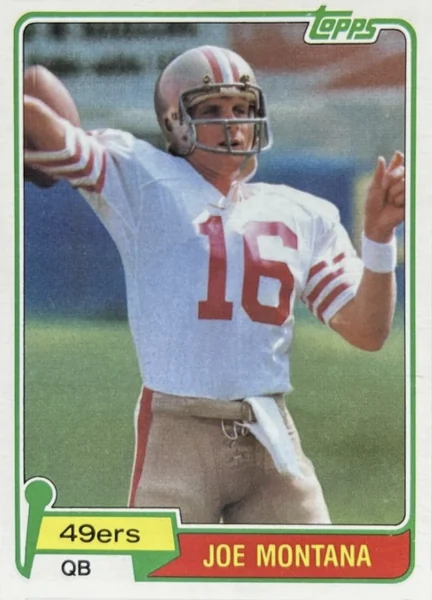
The 1981 Topps set was in stores through the fall of 1981, the season that ended on January 10, 1982, with Joe Montana rolling right against Dallas and putting the ball where only Dwight Clark could get it, 51 seconds left, 28–27. Two weeks later San Francisco beat Cincinnati 26–21 in Super Bowl XVI and Montana was the game’s Most Valuable Player. The card had been in wax packs the whole time. Its back carries his 1980 statistics, seven starts in a year he took the job midway through. It describes a promising young quarterback. By the time the last packs sold, it described a champion.
He had come to the 49ers as the 82nd pick in 1979, a third-rounder from Notre Dame, and started one game that first season. Topps did not print him in 1979 or 1980, so this is his only rookie card, arriving in his third year: number 216 in a 528-card set, sold in 15-card wax packs with a stick of gum, 27-card cellos, rack packs and 500-card vending boxes, a single series with league leaders at the front and playoff cards near the back. Kellen Winslow, Art Monk and Dan Hampton have their first cards here as well, and so, at number 422, does Clark.
The back describes a promising young quarterback. By the time the last packs sold, it described a champion.
The design is white borders, a photograph above a wavy pennant carrying the team name and the player’s, his position printed just outside the banner, the Topps logo in the upper right. The back runs horizontal: a pennant with name, position and card number, then the vitals, then the seasons year by year. The 1980 All-Pros get a black bar near the bottom. Montana’s photograph is posed, white jersey, number 16, the ball drawn back to throw, and his helmet is the tell of the era. Topps held no license from NFL Properties between 1970 and 1981, only an agreement with the players’ association, so its artists painted the emblem off every helmet in the set. This was the last year they had to. The 1982 cards have logos.
Why this card and not another is the simplest question a Montana collector faces. There is no other. A Holsum bread disc and a Coral-Lee postcard exist from those years, and people who like oddities keep them, but the hobby recognizes one rookie card of Joe Montana, and it is this one. The other half of the honesty is that 1981 Topps Football was printed in quantity and sold from grocery racks. The difficulty of number 216 was never in finding one.
The borders are narrow, and a narrow border shows every fraction the cut drifted, so centering is the first thing that goes wrong. The rest is the printing: registration that slips, a smudged nameplate, the occasional diamond cut where the sheet met the blade askew. The stock chips at the corners with handling, as 1981 cardboard does. None of this is unusual for the year. It is only that this card was subject to all of it.
So the object is modest: a posed quarterback on white stock, his helmet scrubbed of its emblem, his statistics a year behind his season. The season caught up to it before the packs were gone.