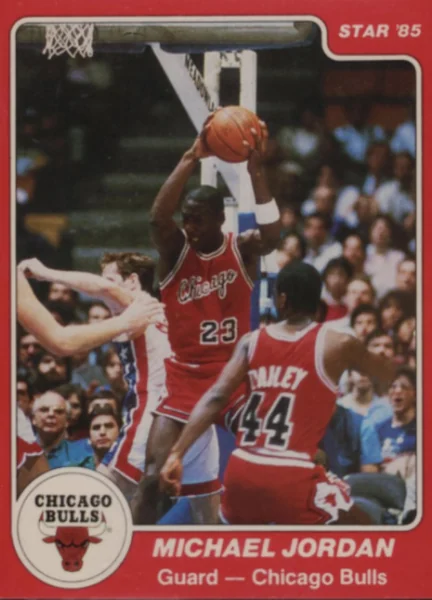

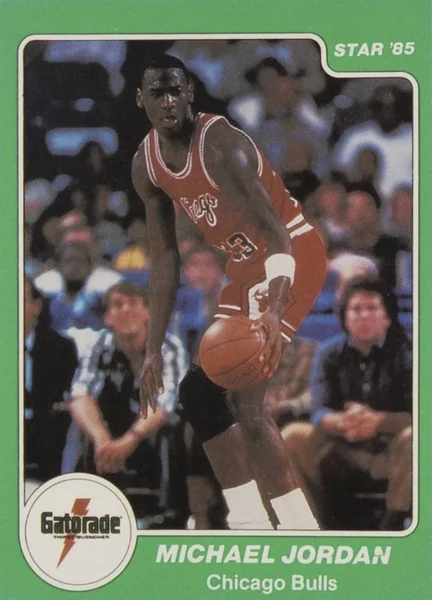
Michael Jordan’s Star card was sold sealed in a clear plastic bag with the rest of the Chicago Bulls, and #101 was the card at the front.
In the years between Topps’s last basketball set, in 1981-82, and Fleer’s in 1986-87, the Star Company was the only maker of NBA cards. It sold no wax packs. Each team’s cards came sealed in a polybag, sold to wholesalers and hobby dealers, much of it by mail order, and some parts of the country saw few or none. The 1984-85 set had 288 cards arranged by team, with the Bulls at #101 to #112, and according to Beckett it came out in the spring of 1985. The owner, Robert Levin, has said he aimed for 5,000 of each card and fell short; estimates for each team set run from about 3,000 to 8,000.
The border is red, the Bulls’ color, with STAR ’85 in the upper corner. Jordan, in the red road jersey with Chicago written in script and the number 23, rises with the ball held in both hands above his head, taking a rebound. A teammate, Quintin Dailey, number 44, has his back to the camera, and the crowd fills the rest. The Bulls’ logo sits in a white circle at the lower left, beside MICHAEL JORDAN and Guard — Chicago Bulls. Levin later said it was the best photograph of Jordan he had.
Anyone who bought the Bulls bag got Michael Jordan, at the front.
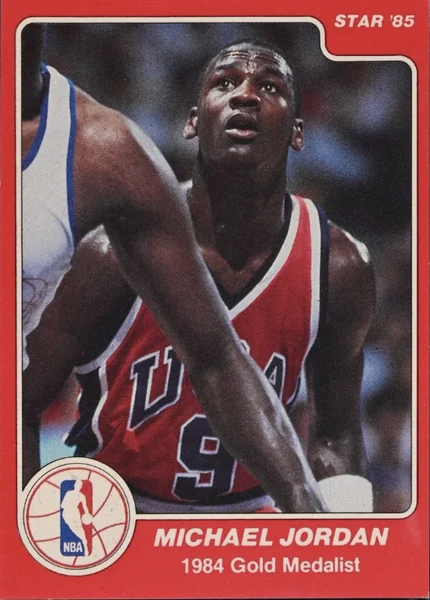
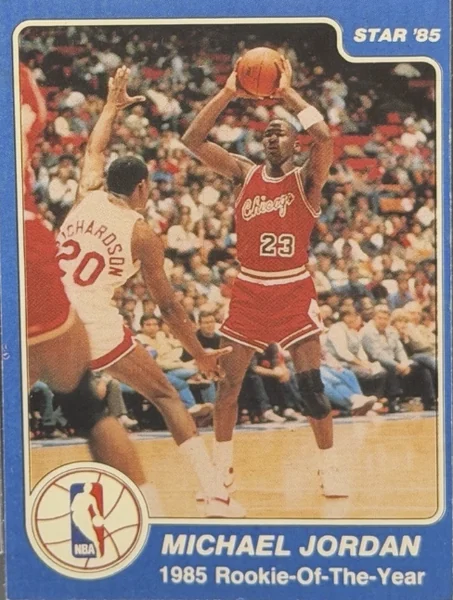
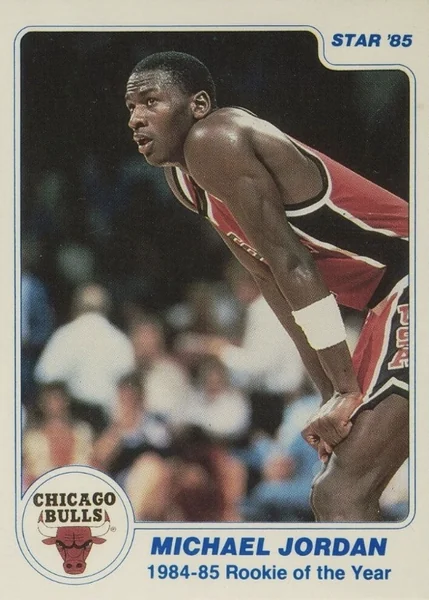
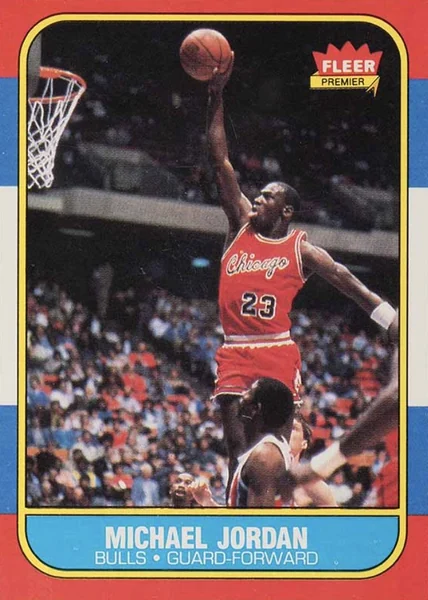
Because the card was never sold in packs, Beckett has listed it since 1990 as an extended rookie card rather than a rookie card: anyone who bought the Bulls bag got Jordan. The hobby gives the rookie title to the 1986 Fleer. Sports Collectors Daily calls the Star #101 the first licensed card to show him as an NBA player. He appears twice more in the same set, with the 1984 Olympic team and as Rookie of the Year, alongside the first cards of Charles Barkley, John Stockton and Akeem Olajuwon.
Chicago had drafted him third that June. He played all 82 games of his first season, averaged 28.2 points, made the All-Star team and was named Rookie of the Year. Six championships followed, each with the Finals MVP award, and five MVP seasons.
Being the front card in the bag cost #101 something. It rubbed against the plastic, though a buyer could check its centering through the bag before opening it. Star’s cards were often miscut, the thin red borders chip, and counterfeits exist: originals are not glossy, and the border and image should be crisp.