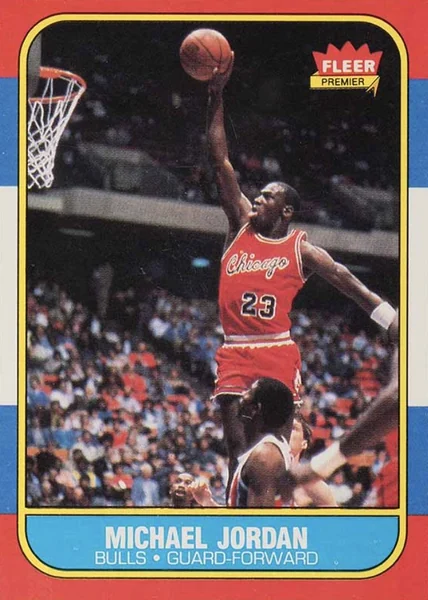
Every hobby has a single object that everything else is measured against. For modern sports cards, this is it — and the story of why is better than the price tag.
By the mid-1980s, basketball cards had nearly vanished. Topps had walked away from the sport after the 1981–82 season, and for a few quiet years the only game in town was a small company called Star, whose cards came sealed in team bags and never quite caught on. Then, in the fall of 1986, Fleer returned basketball to the classic wax pack — cardboard, stickers, and a stick of gum — and the modern era began. The set ran just 132 cards. Tucked inside, at number 57, was a second-year guard from Chicago caught in mid-air, tongue out, soaring over a pair of Nets toward a dunk the photographer was lucky to catch at all.
It is the image the entire hobby grew up around.
What makes a high-grade example so devastatingly rare is almost poetic: the card was nearly impossible to keep perfect. Those vivid red borders show the faintest handling like a fingerprint on glass — a soft corner, a whisper off-center, and a gem-grade dream becomes an ordinary copy. The cards were made to be shuffled, traded, tacked to bedroom walls and tucked into bicycle spokes. The ones that survived untouched did so almost by accident. That is the quiet drama behind every grade: you are not only paying for Jordan. You are paying for the small miracle that this particular piece of 1986 escaped its own decade unharmed.
Which is why it remains the first card most serious collectors reach for, and the one they are proudest to have reached. It is the anchor of our Hardwood index and, by most measures, the anchor of the hobby itself. If a collection of this era can be said to have a heart, this is where it beats.