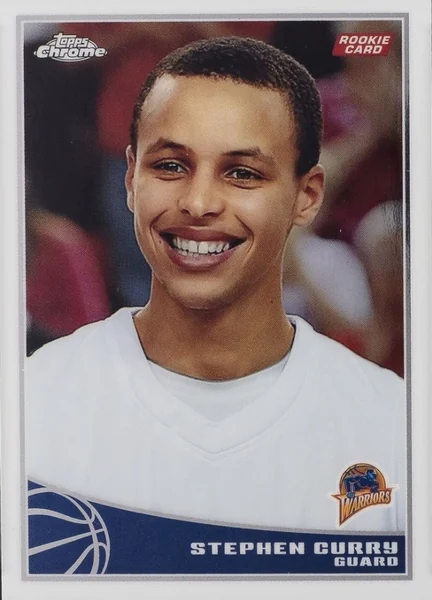
The license was already gone. On January 27, 2009, the NBA named Panini its exclusive card licensee beginning with the 2009–10 season, and Topps, which had printed basketball every year since 1992–93, said the terms did not make sense for it and stepped away. One product remained. That fall Topps released 2009–10 Topps Basketball, 330 cards with the rookies at the end, and then made no licensed NBA card for sixteen years. Stephen Curry is number 321 in that set. He is number 101 in this one.
Topps Chrome that year was not a product of its own. It was a run of 110 cards, Chrome versions of the flagship design, seeded into hobby boxes of the paper set rather than sold under their own name, and every one of them is numbered on the back to 999. There is no unnumbered Curry Chrome; the base is itself a limited print. Above it sit the Refractor at 500 copies, the Gold Refractor at 50, and a Superfractor of one that has never been seen in public. That structure, and the year, are why collectors settled on this card rather than the paper 321: it is the last Topps Chrome rookie in basketball until the company came back, and every copy carries its count.
There is no unnumbered Curry Chrome. The card the hobby calls the base is itself a limited print.
What it recorded was a seventh pick. Golden State took him on June 25, 2009, at Madison Square Garden, a junior from Davidson College in North Carolina who had led the country in scoring at 28.6 points a game and whom six teams had passed on. He was good at once, 17.5 points as a rookie, second to Tyreke Evans for Rookie of the Year. Then the right ankle turned, and kept turning. Surgery in consecutive years, 40 of 66 games missed in 2011–12, and on October 31, 2012, a four-year, $44 million extension both sides understood as a discount for the risk. The Most Valuable Player awards came in 2015 and 2016, the second unanimous, and the championships in 2015, 2017, 2018 and 2022. The card knew none of that. It knew 999.
Chrome ages the way chrome does. The image is printed in reverse on a clear plastic sheet and laminated to a metallic backing, so the picture is seen through the plastic and the shine comes from behind it. Paper and plastic take up humidity at different rates, which is why these cards tend to curl, and why one that lies flat is a small achievement. The surface holds print lines from the press and fine scratches from the cards packed around it, and under angled light both read larger than they are. The Refractor adds a second foil layer and a second set of things that can go wrong.
It was the end of a seventeen-year run, and nothing on the card says so. No final-issue stamp, no farewell on the back, only a design Topps expected to print again the following autumn and did not. The company returned to basketball in October 2025 with Cooper Flagg on the box. For the sixteen years between, this was its last word: a Chrome card of a seventh pick, numbered to 999, from a set printed after the league had already given the license to someone else.