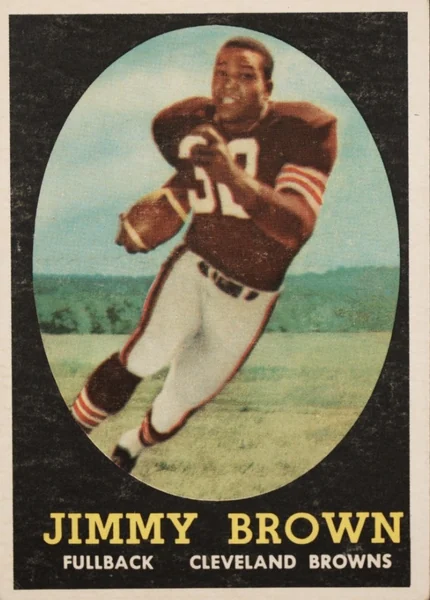
For nine seasons, professional football tried to tackle Jim Brown, and for nine seasons it mostly failed. He led the league in rushing in eight of them — a level of sustained dominance that has no real equal in the sport's history — and he did it as a man who looked carved from something harder than the players bouncing off him. He never missed a game. He was, by the testimony of nearly everyone who watched him and everyone who tried to stop him, the single most unstoppable athlete the game has ever produced. The debate over the greatest running back of all time tends to be short, and it tends to start and end with his name.
What is easy to forget is how complete an athlete he was before football ever claimed him. At Syracuse he earned letters in multiple sports and was, by many accounts, one of the finest lacrosse players the country has ever seen — a man who might have been an all-time great in a second sport entirely. He brought that rare, total athleticism to the backfield, where his combination of power and speed and balance simply did not exist anywhere else. He was not a great back for his era. He was a player the era had no answer for, and arguably still wouldn't.
At the height of his powers, with nothing left to prove, he simply walked away — greatness on his own terms.
And then came the decision that sealed the myth. At twenty-nine years old, still the best player in football, still rewriting the record book every autumn, Brown retired. He left for Hollywood, for a second act as a leading man on the silver screen, and for a life of activism and advocacy that would prove as consequential as anything he did on the field. He refused to let the game define the limits of his life. In an era when athletes were expected to be grateful and quiet, Brown was neither — he was proud, outspoken, and entirely his own man, using his stature to push for change. He walked away from football because he had decided there were larger fields to play on.
His cardboard carries that same gravity. A Jim Brown card is self-possession itself — the athlete who dominated utterly and then declined to be owned by his own legend. His rookie card is not just the key to a vintage football set. It is the first card of the man every running back since has been measured against, and it carries the weight of someone who was the best, knew it, and still believed he was meant for more.
Most greats played until the game let them go. Brown left on his own terms, at the very top — and somehow that made him larger still.