On April 5, 1984, in a Lakers home game played in Las Vegas, Kareem Abdul-Jabbar took a pass from Magic Johnson on the right block, turned, and let go of the shot everyone in the Thomas & Mack Center had come to see. Mark Eaton, the Utah center, was seven foot four and could not reach it. The basket gave him 31,420 points, one more than Wilt Chamberlain had scored in his career, and the game stopped. He was 36. He played five more seasons and added nearly 7,000 more, and for thirty-nine years after that night his name sat at the very top of the list.
He had been Lew Alcindor first, born in New York in April 1947, and by the time he left Power Memorial Academy the school had won 71 games in a row. At UCLA under John Wooden he won three national championships in three seasons, 1967 through 1969, and lost two games in that span. The college game banned the dunk after his first varsity season and did not restore it until 1976. Milwaukee won a coin flip for the first pick in 1969, took him, and had a Rookie of the Year that spring and a championship the next. He had converted to Islam in 1968, quietly. He announced the new name on June 3, 1971, weeks after the title, when there was nothing left to prove under the old one.
Mark Eaton was seven foot four and could not reach it. Nobody could.
Milwaukee traded him to Los Angeles in 1975 for four players. Six Most Valuable Player awards in all, in 1971, 1972, 1974, 1976, 1977 and 1980, a figure nobody has matched. Five titles with the Lakers, six in all. In the fifth game of the 1980 Finals he scored 40 points on a badly sprained ankle, then sat out the sixth, and a twenty-year-old Magic Johnson started at center in his place and the Lakers won anyway. He was Finals MVP again in 1985, at 38, the oldest ever. He retired in 1989, at 42, after twenty seasons and 1,560 games, the last a Finals loss to Detroit. The skyhook retired with him. Nobody has made it a signature since.
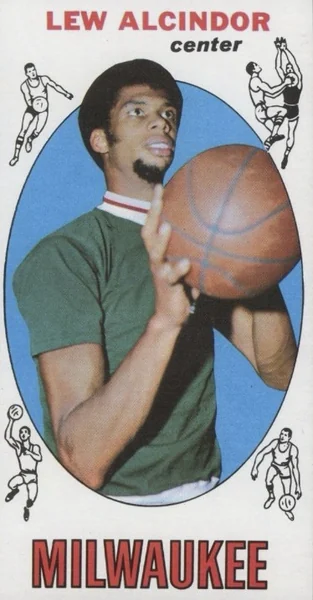
Topps had not printed a basketball card since 1957–58, and when it returned for 1969–70 it did so in a tall format, two and a half inches wide and nearly five tall, a 99-card set that put each player in an oval frame. The packs came with rulers, cartoon inserts marked off in inches, because height was the thing being sold. Card 25, of a Milwaukee rookie named Lew Alcindor, was the best argument for the shape. The card carries the name he was already preparing to set down.
The second career was on the page. Giant Steps, his autobiography, appeared in 1983 while he was still playing; a history of the 761st Tank Battalion followed in 2004, a Sherlock Holmes novel about the detective’s older brother in 2015, and a memoir of his fifty years with Wooden in 2017. He trained with Bruce Lee and fought him on film. He was the co-pilot in Airplane! in 1980 and let the joke be on him. In 2016 he received the Presidential Medal of Freedom.
On February 7, 2023, he sat in a baseline seat near the Lakers bench and watched LeBron James pass him against Oklahoma City, then held the ball up and handed it over. He had held the record longer than the man taking it had been alive. That is the kind of arithmetic his career produces, and he has always seemed to find it less interesting than the next book.