Larry Bird grew up in French Lick, Indiana. He lasted less than a month at Indiana University, went home, and worked municipal jobs for a year before enrolling at Indiana State in 1975. Four seasons later the Sycamores went 33–0 and reached the 1979 national championship game, where they lost to Magic Johnson's Michigan State.
Boston had drafted him the spring before, sixth overall, after his second season at Indiana State, and waited a year for him. In his first season the Celtics won thirty-two more games than they had the year before, and he was Rookie of the Year. Championships followed in 1981, 1984 and 1986, and the Most Valuable Player award in 1984, 1985 and 1986. Bill Russell and Wilt Chamberlain are the only others to win it three years running.
He asked the room who was finishing second, then went out and won.
He wasn't fast and didn't jump especially high. What he had was a shooter's touch and a sense, half a second early, of where everyone on the floor was going. He also talked, and the stories about it are mostly true. Before the first All-Star three-point contest, in 1986, he walked into the locker room and asked the other shooters which of them was finishing second. He won that year and the next two.
Against Portland on February 14, 1986, he made ten of his field goals left-handed and finished with 47 points, 14 rebounds and 11 assists in an overtime win. He said he was saving his right hand for the Lakers, whom Boston played two nights later.
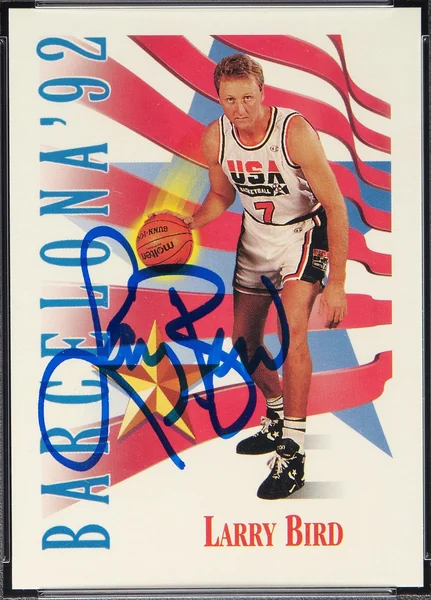
His back gave out before his skill did. He announced his retirement in August 1992, after winning Olympic gold with the Dream Team. Then he went to Indiana: he was Coach of the Year with the Pacers in 1998, took them to the 2000 Finals, and as their president was Executive of the Year in 2012.
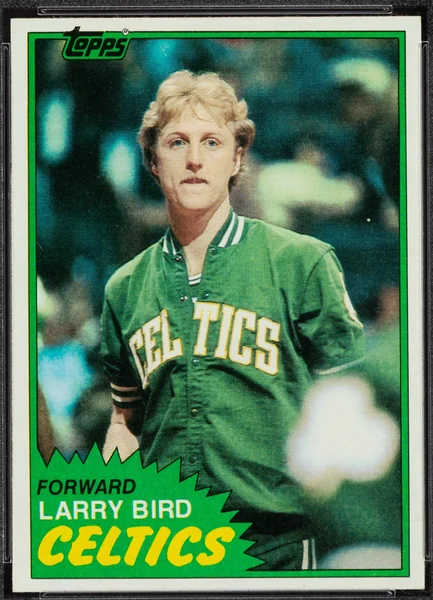
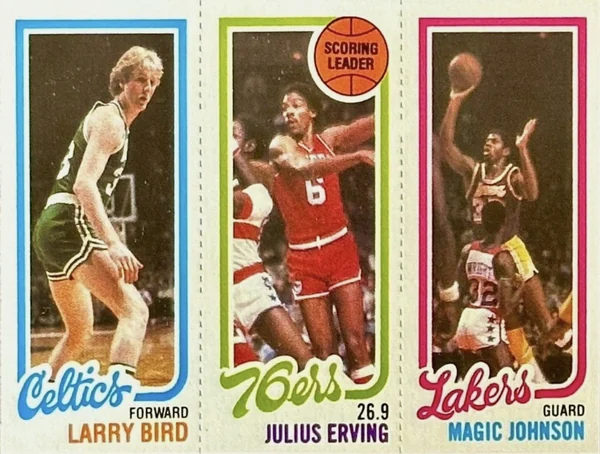
His first card is the same 1980–81 Topps panel as Magic Johnson's, three small cards on one perforated piece, Julius Erving's among them. It is the first card of either man, and it belongs to both.