On the morning of May 2, 1939, in the lobby of the Book-Cadillac Hotel in Detroit, Lou Gehrig found his manager, Joe McCarthy, and told him he was taking himself out of the lineup. He had played every Yankees game since June 1925. He was batting under .150 and could not say why. McCarthy asked him to carry the lineup card to home plate anyway, as the captain did, and when the announcer told the crowd at Briggs Stadium what the card meant, there was a silence and then a long cheer. Gehrig tipped his cap and sat down. Babe Dahlgren played first base. The Yankees won 22–2, and he never played again.
He was born in Manhattan in 1903 to German immigrants, went to Columbia on a football scholarship, and signed with the Yankees in 1923. The streak began quietly, a pinch-hitting appearance and then a start at first base in place of Wally Pipp, who had a headache. He drove in 184 runs in 1931, which remains the American League record; hit four home runs in one game at Shibe Park in Philadelphia on June 3, 1932, and nearly a fifth; and won the Triple Crown in 1934 with a .363 average, 49 home runs and 165 runs batted in. He was Most Valuable Player in 1927 and 1936. He retired with a .340 average, 493 home runs, 23 grand slams, the record until 2013, and six World Series championships.
There was a silence, and then a long cheer. He tipped his cap and sat down.
For most of it he batted fourth, one place behind Ruth, which suited him. Ruth was the show. Gehrig was the man who came up next. The four-home-run game shows how that went: it happened on the same day John McGraw resigned as manager of the Giants, and the New York papers gave McGraw the front page. Gehrig does not seem to have minded. He was a reserved, careful man who did not marry until he was 30, and the streak was less a feat of will than a habit he saw no reason to break.
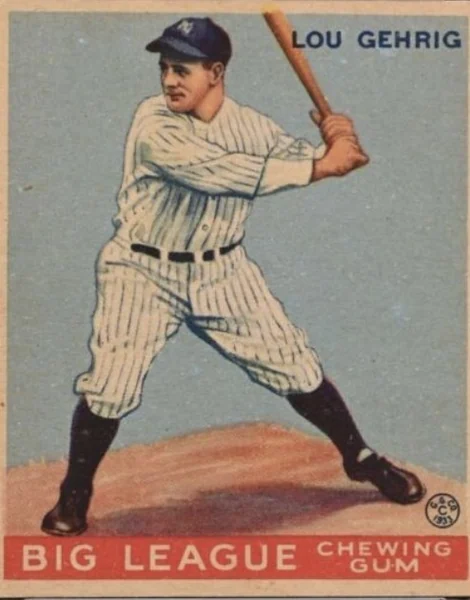
His 1933 Goudey card, number 160, is one of two of him in that set, the other being number 92, and the two share the same image: a painted rendering of a Charles Conlon photograph, Gehrig in pinstripes in mid-swing, on the small cards that Goudey of Boston sold for a penny with a slab of bubble gum. What distinguishes 160 is the background, a deeper blue than its twin, and its place on a later printing sheet, which is why it turns up less often. It sits in the set the way he sat in the lineup: near the Ruths, and holding its own.
The Mayo Clinic confirmed the diagnosis on June 19, 1939, his 36th birthday: amyotrophic lateral sclerosis, which now carries his name. On July 4, between games of a doubleheader, in front of 61,808 people at Yankee Stadium, he was at first too moved to speak and had the master of ceremonies say so. The crowd would not accept it. He went to the microphone and, in under three hundred words, called the news a bad break and himself the luckiest man on the face of the earth, and Ruth, estranged from him for years, came over and put his arms around him. In December the writers voted him into the Hall of Fame without waiting. The Yankees retired his number 4, the first number any club had retired. He served the city as a parole commissioner for as long as he could, and died in the Bronx on June 2, 1941, sixteen years to the day after he had replaced Wally Pipp.