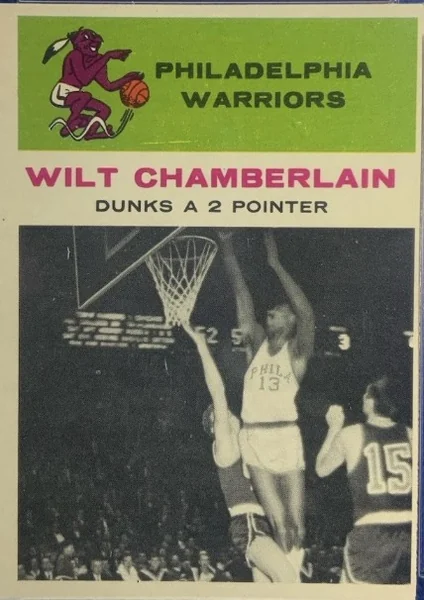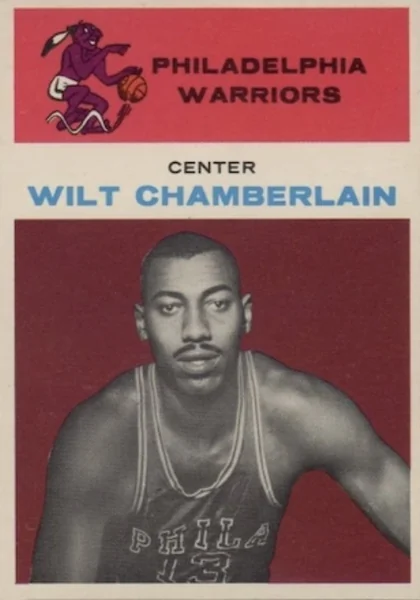
On the second of March, 1962, in a half-empty arena in Hershey, Pennsylvania, Wilt Chamberlain scored one hundred points in a single basketball game. There is no film of it. There is a single grainy photograph of him holding a handwritten sign that reads "100," and the word of everyone who was there. More than sixty years later it remains the most famous number in the sport — and somehow it is not even his most absurd.
That same season he averaged 50.4 points a game. Not in a game; for the entire year. He also averaged nearly 26 rebounds a night, played all but eight minutes of every game, and was, by the consensus of everyone who shared a floor with him, simply built on a different scale than the league he entered. He stood seven-foot-one when that height was not yet common, and he moved like a far smaller man.
He averaged fifty points a game for an entire season — a number so far past reason it sounds invented.
The record book is where the legend lives. He once pulled down 55 rebounds in a single game. He led the league in scoring seven times and, in 1968, led it in assists too — for one season only, and largely to prove that he could, that the dominance was a choice and not a limitation. In more than a thousand professional games, against the hardest fouling the era allowed, he never once fouled out. The numbers do not merely lead their categories; several of them sit at the edge of what seems humanly possible.
For years his legend wore an asterisk, and its name was Bill Russell. Russell's Celtics won the titles; Chamberlain, for all the records, won only two. But time has been kinder and more honest. The rivalry now reads as the greatest in the sport's history precisely because both things were true at once: Russell won, and Chamberlain was unmatchable. Wilt eventually got his rings — in 1967 with Philadelphia and in 1972 with Los Angeles — and the "loser" framing has fallen away, leaving the plain fact of the most overpowering force the game has known.
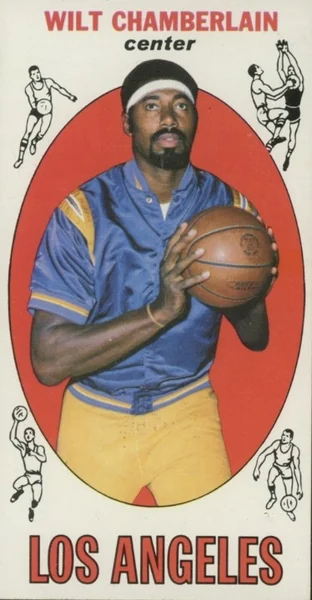
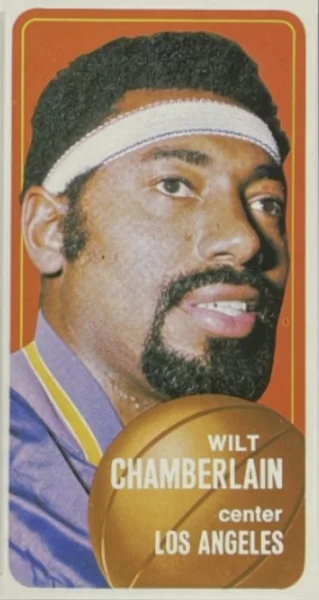
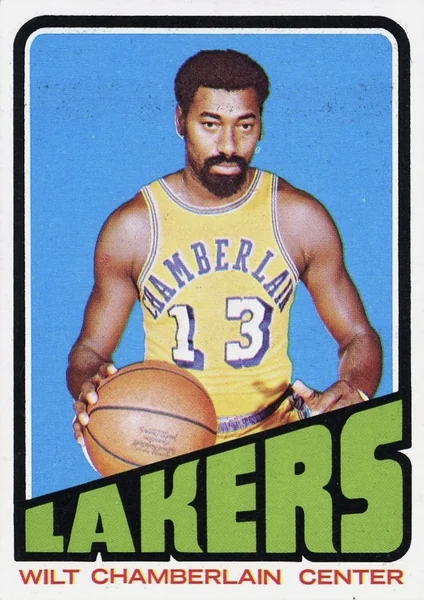
A Wilt card is the origin point of basketball's idea of the unstoppable big man. Every dominant center since is measured against the one who scored a hundred. His cards are scarce in a way the modern hobby barely remembers, because in his era the sport's collectibles scarcely existed at all. That scarcity is part of the reverence. There simply isn't much of him to hold, which makes each piece feel like a relic of a taller, stranger age.