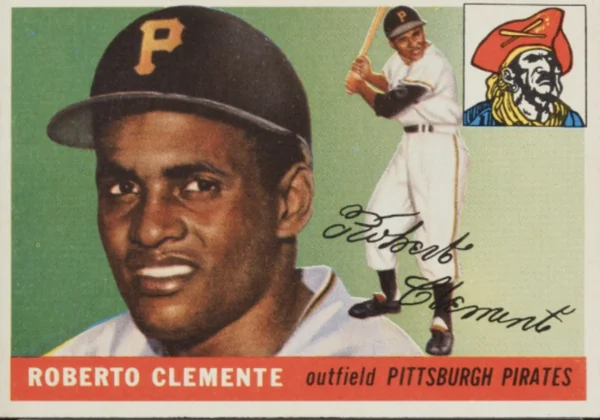
To many collectors the 1955 Topps set is one of the most beautiful the company ever made. Tucked into its scarcer half is the first card of a man the hobby holds in singular esteem. It is among the most coveted post-war baseball cards in existence, and the reasons run to design, scarcity, and plain reverence.
Consider the set first. In 1955 Topps did something it had never done and turned the card on its side. Every card is horizontal, pairing a large color portrait with a secondary action image against bright, saturated backgrounds — a cinematic look that has aged into one of the most admired designs of the era. It was a comparatively small set, and it carried the rookie debuts of three Hall of Famers: Sandy Koufax, Harmon Killebrew, and, at number 164, Roberto Clemente.
Among the three Hall of Fame rookies in the set, Clemente's is the hardest of all to find truly pristine.
Here is the detail that separates this card from its famous setmates. Clemente's rookie falls in the set's high-number series — the cards printed in smaller quantities and distributed late, which makes them markedly tougher to find today, especially in high grade. Of the three Hall of Fame rookies in the set, Clemente's is by some distance the most elusive in elite condition: graded in the top tiers far less often than the Koufax or the Killebrew from the very same set. So the card carries a double scarcity — the natural attrition of any seventy-year-old cardboard, compounded by a smaller print run to begin with. The pristine survivors are genuinely rare, and have been for as long as anyone has been counting them.
And then there is the quiet poetry collectors love. The back of this very card, written when Clemente was a twenty-year-old unknown, foretold his "powerful throwing arm" — the arm that would win him twelve Gold Gloves and become one of the most feared weapons in the history of the position. The card predicted the legend before the legend happened. That is the romance of owning it: it is not just the first card of a transcendent player and humanitarian, but a small printed prophecy of everything he was about to become. The finest examples reside in the rarest air of the hobby — but for a Clemente, the meaning was always going to run deeper than the number.