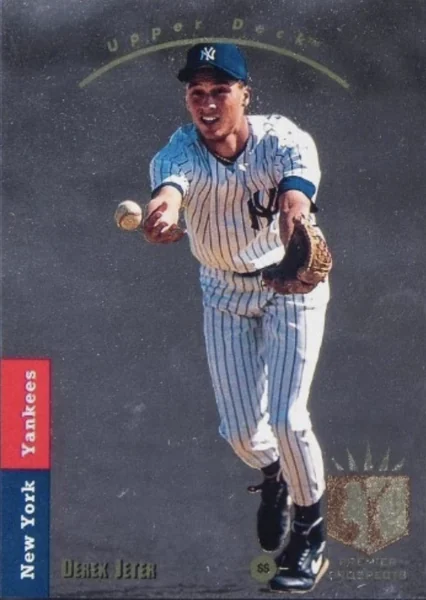
Upper Deck never said what the two letters stood for. The product reached shops on August 23, 1993, having nearly been called Upper Deck XL, and the hobby decided for itself that SP meant Super Premium. 1993 was the year the manufacturers discovered the upper shelf: Topps had Finest, Fleer had Flair, and Upper Deck had this, 290 cards in twelve-card packs, 24 packs to a box. The checklist opens with 18 All-Stars, runs through the league by team, and ends with 20 Premier Prospects, numbers 271 through 290. Derek Jeter is 279.
Those last 20 look different. The base cards are near-borderless photographs with a thin stripe along the bottom for the name and a bronze SP mark; the Premier Prospects were given an all-foil front, the first time a baseball card had been foil-etched across its entire face. In a set with Rickey Henderson, Greg Maddux and George Brett in it, the twenty nobody had heard of got the finish. Johnny Damon is 273, Chipper Jones 280. The die-cuts in the box were the Platinum Power inserts, one in nine packs; the prospects were cut square, but the foil makes their corners behave as if they were not.
In a set with Henderson, Maddux and Brett in it, the twenty nobody had heard of got the finish.
The man on 279 was in his second professional summer and had done nothing to suggest the card should be kept. Five college players went ahead of him on June 1, 1992, before the Yankees took him sixth out of Kalamazoo Central High School for $800,000 and a scholarship to Michigan forgone. In the Gulf Coast League that summer he went hitless in his first 14 at-bats and finished at .202. When this card was printed he was at Greensboro, North Carolina, in Class A, on his way to 56 errors at shortstop and a season that raised the question of whether the position was his. The foil made him look like a star before anyone had decided.
He has seven other cards from 1993, among them the Topps 98 and the Upper Deck 449, from the sets that had been the default for every rookie before him. This one won because of when it was made. The early 1990s were the hobby’s foil years, when a shine was the mark of seriousness, and Upper Deck, four years off the hologram and the white stock that had changed the industry in 1989, was the company whose claim to the upper shelf was believed. The card looked like the future. Once the shortstop turned out to be, the choice had already been made.
The surface is the story of its condition. Foil on a dark ground shows every disturbance in white: where a corner has been pressed, the metallic layer lifts and leaves a pale fleck that reads from across a room, and along the edges the flaking often begins before the pack is opened, so that a fresh card can already carry a bright, irregular seam where the dark foil ends. The design has no border, so there is no frame to measure the photograph against, and a card that is off by a little is hard to tell from one that is not. It was made to be looked at, and looking at it is what wears it down.