The throw from right field was already past everyone when Derek Jeter arrived. It was October 13, 2001, in Oakland, the seventh inning of a game the Yankees led 1–0 and a series they trailed two games to none. Terrence Long had doubled down the right-field line, Jeremy Giambi was being waved home from first, and Shane Spencer’s relay sailed over both cutoff men and bounced toward the first-base line, where no shortstop has any business being. Jeter was there anyway. He caught it on the run, flipped it backhand to Jorge Posada, and Giambi, who did not slide, was out by a step. The Yankees won that night, and the next day, and the series. Nobody has ever fully explained what he was doing on that side of the diamond, including him.
He was born in Pequannock, New Jersey, and raised from the age of four in Kalamazoo, Michigan, the son of two Army veterans who had him sign a contract each year setting out what they expected of him in school and out of it. The Yankees took him sixth overall in 1992 out of Kalamazoo Central High School. He was in the Bronx to stay by 1996, hit .314, and was the unanimous Rookie of the Year on a team that won the World Series. Three more titles followed in 1998, 1999 and 2000, the last with Jeter as Most Valuable Player of both the All-Star Game and the Series in the same year, which nobody had done before.
Nobody has ever fully explained what he was doing on that side of the diamond, including him.
The moments accumulated in a way that made the totals seem almost beside the point. A home run just after midnight on November 1, 2001, in a World Series pushed into that month by the attacks on the city seven weeks earlier. A headlong dive into the seats along the left-field line against Boston in July 2004 that left his chin cut and the ball in his glove. A 3,000th hit in July 2011 that was a home run off David Price. Underneath all of it, 3,465 hits, sixth on the all-time list, a .310 average, 14 All-Star selections, and a 2003 captaincy the franchise had left vacant since 1995. Others at the position hit for more power or covered more ground. He was the one you wanted at the plate in the ninth.
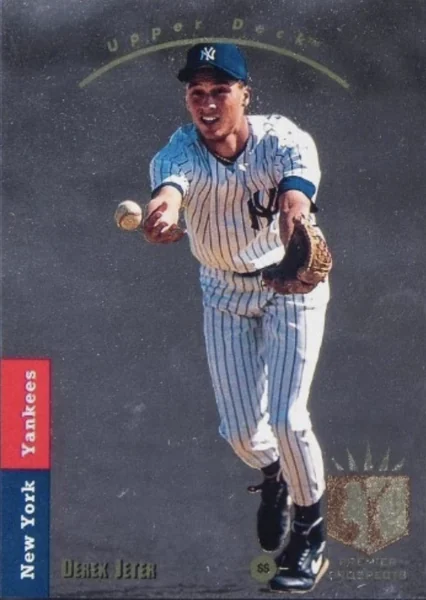
His 1993 SP card, number 279, is the rookie collectors chose, and the choosing was partly an accident of manufacture. SP was Upper Deck’s first premium brand, and its Premier Prospects subset at the end of the checklist was printed with an all-foil front, a surface that photographs beautifully and survives almost nothing: it chips at the edges, shows every fingerprint, and reveals corner wear the way a mirror reveals dust. The man kept himself unmarked for twenty years in the least forgiving city in the sport. The card rarely manages it.
The last home game was September 25, 2014, against Baltimore. The Yankees had given away a three-run lead in the ninth, which meant he came up with a runner on second in a tie game, and he did what he had been doing for twenty years: an inside-out single to right field, the winning run sliding home, the building coming apart. Three days later he retired in Boston. In 2020 the writers put him in the Hall of Fame with 396 of 397 votes, and the one who left him off never came forward, which seems a fitting last chapter for a man who spent two decades in New York giving the press nothing to write about but the games.