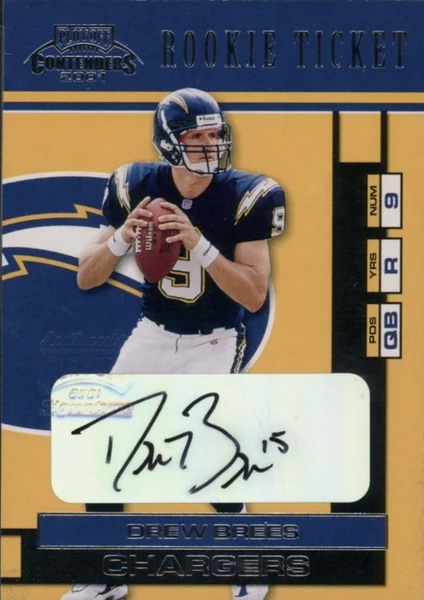
Thirty-one players were taken before him. The 2001 draft opened with Michael Vick and an arm that could throw sixty yards off the wrong foot, and by the time the first round closed, every team in the league had passed on the quarterback from Purdue at least once. San Diego took him with the very next pick, the first of the second round. The card in front of you was signed by a man nobody had yet decided was worth a first-rounder.
He would finish his career having thrown for more yards than any quarterback in the history of the game. He would win a championship in a city still counting what the water had taken, and be named the most valuable player of that game. The distance between the thirty-second pick and that record is the entire reason a rookie signature is worth keeping: it is a name written down before the answer was known.
A name written down before the answer was known.
The Rookie Ticket is the same form the house holds for Manning three years earlier and Brady the year before this one — a card printed to resemble a ticket stub, with a band across the bottom for the player’s signature. In 2001 that signature went onto a foil sticker, signed at a table and applied to the card afterward, a method Playoff used for several years and collectors have never loved. It changes nothing about whose hand it is. The pen behaved or it did not, and graders assess the signature separately from the cardboard, so two things must have gone right on the same object, one of them at a signing table a quarter-century ago.
It is also why this card replaced the Bowman Chrome Refractor the house tracked before it. The Refractor is a handsome card and an honest one, but it is not the Brees collectors chase, and too few copies stood available to say anything reliable about its price. This one trades. Several copies sit available in the grade serious collectors target, which is what makes a number mean something. Between the two, one is a picture of a quarterback; the other is his hand on the card.