In March 2006 the Miami Dolphins brought Drew Brees to town to sign him, and then did not. On the last day of the 2005 season, in San Diego, he had torn the labrum in his throwing shoulder; James Andrews rebuilt it days later. Miami’s doctors looked at the repair and told Nick Saban they did not think he could play. San Diego had already moved on to Philip Rivers. That left New Orleans, a franchise that had gone 3–13 the previous fall with no home to play in, and a first-year head coach, Sean Payton, who wanted him. He signed on March 14, 2006. The Superdome had been a shelter during Hurricane Katrina and a wreck afterward, and nobody yet knew whether the city would come back, never mind the team.
He was from Austin, Texas, where he had quarterbacked Westlake High School through an unbeaten season to a state championship in 1996. Purdue took him. He left West Lafayette holding thirteen Big Ten records, third in the Heisman voting, and the school’s first Rose Bowl in a generation, and in April 2001 thirty-one players were still taken ahead of him. In San Diego he made a Pro Bowl in 2004, and then he got hurt.
Nobody yet knew whether the city would come back, never mind the team. He signed anyway.
The Superdome reopened on September 25, 2006, a Monday night against Atlanta. Steve Gleason blocked a punt in the first quarter, the Saints won 23–3, and the season ran all the way to the conference championship game. Then the numbers came in volume. He threw for 5,476 yards in 2011, past Dan Marino’s twenty-seven-year-old mark, and reached 5,000 in five different seasons; no one else has managed it more than twice. He completed 74.4 percent of his passes in 2018. He threw a touchdown pass in 54 consecutive games, breaking a record Johnny Unitas had held since 1960.
The championship came on February 7, 2010, in Miami, of all places. He completed 32 of 39 passes for 288 yards and two scores against Indianapolis, Payton opened the second half with an onside kick nobody expected, and the Saints won 31–17, the first title in their history. He was the game’s Most Valuable Player, and the photograph everyone kept was of him in the confetti, holding his infant son.
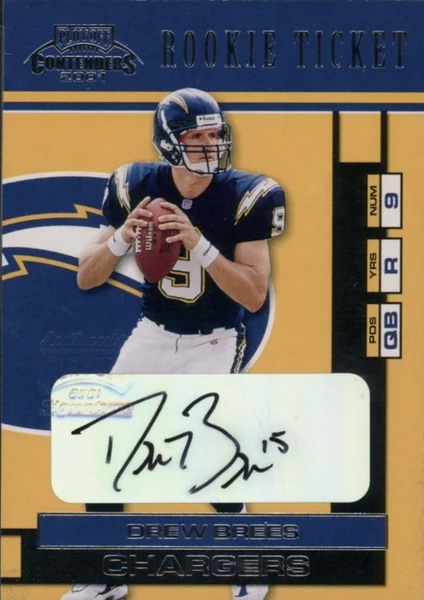
His 2001 Playoff Contenders Rookie Ticket is the card, in the form the hobby settled on for quarterbacks of his era: a card printed to resemble a ticket stub, the signature across the lower band. Contenders had introduced the idea in 1998, and by 2001 the checklist ran to a hundred rookies; he shares the year with Michael Vick and LaDainian Tomlinson, and it says something about that draft that his was not the ticket anyone was chasing. One thing worth knowing: in 2001 the signature went on a foil label rather than onto the cardboard, a method the company kept for several years and collectors have never loved. It remains the hand of a thirty-second pick, before New Orleans and before the shoulder.
He retired after the 2020 season holding the career records for passing yards, 80,358, and completions, 7,142, with 571 touchdown passes. Only Tom Brady, who played two more years, has thrown for more. He spent his New Orleans years building things, schools and playing fields and a foundation for the city’s recovery, and when the Hall of Fame enshrined him in Canton, Ohio, on August 8, 2026, Sean Payton presented him, which was the only sensible choice. The quarterbacks he is measured against were taller and drafted higher. None threw the ball more accurately, and none has meant more to the place he played.