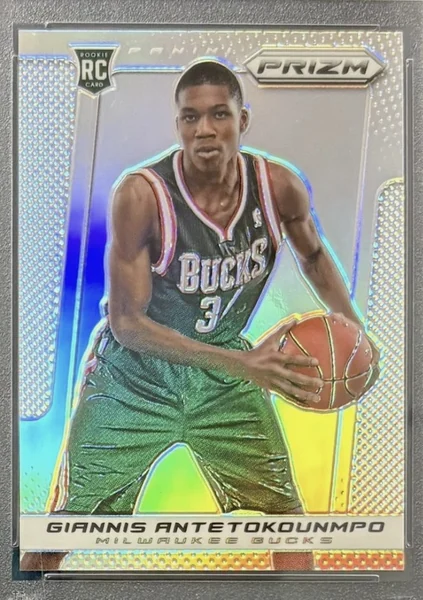
The boxes reached shops on December 27, 2013, three weeks after the boy on card 290 turned nineteen. Milwaukee was on its way to 15–67, the worst record in the league that season, and its fifteenth pick was averaging under seven points a game. Nobody was opening Prizm for him. The product was the draw, in only its second basketball season, and the checklist ran 297 cards, a number Panini chose because it filled thirty-three nine-pocket pages exactly, with the rookies at the end, 261 through 297.
Prizm in 2013–14 was not yet what it became. Panini had launched it the year before as its chrome line, built on a finish it called Opti-Chrome, and the second edition mostly added colors: Gold at ten copies, Orange at sixty, a Black one-of-one, a Red for Target and a Blue for Walmart. A hobby box held twenty packs of six cards and promised five Prizm parallels in all, which meant the unnumbered Silver, the first refractor rung, was itself something to find. Five years later a box would promise twenty-two. The Silver of this set is the same idea at a stricter ration: a mirrored foil under the photograph that turns the light to color, and no serial number to say how many were made.
Nobody was opening Prizm for him. The product was the draw; the fifteenth pick came with it.
He had come from Filathlitikos, a club in the Greek second division, where he averaged 9.5 points and 5 rebounds over 26 games, and Milwaukee took him on June 27, 2013, at eighteen, with that much film to go on. The card records what there was to record: a Bucks jersey and a rookie’s place at the back of the checklist. What followed is the sport’s best argument against ranking rookies in December. Most Improved Player in 2017, Most Valuable Player in 2019 and 2020, a championship in 2021, and thirteen seasons in one city before the trade to Miami in the summer of 2026.
Why this card rather than his other rookies is mostly the set’s later reputation borrowed backward. In 2013 there were other products and other Antetokounmpo rookies, and no one had decided Prizm was the standard. It became the standard through the classes that followed, and once it had, the hobby went back and found him waiting at 290 of the second edition. The Silver is the version because it is the rung the set is organized around, not the base, which lacks the refractive finish, and not the numbered colors, which are too few to be anyone’s reference copy.
The trouble with the Silver is the finish that makes it. The foil shows scratches from the wrapper and from every card that ever slid across it, print lines the press left behind, and a cloudiness that comes from moisture or the oils of a hand, and all of it appears larger under angled light than it is. A 2013–14 Silver that has gone thirteen years without a mark on its face is a card someone set aside in a season when there was no reason to set it aside, which is the whole quiet interest of the thing.