On July 20, 2021, three weeks after his left knee had bent the wrong way in Atlanta, Giannis Antetokounmpo scored 50 points in the sixth game of the NBA Finals, took 14 rebounds, blocked 5 shots, and gave Milwaukee its first championship since 1971. He was 26. He could have left the winter before; the league had spent a year guessing where he would go. Instead, in December 2020, he signed a five-year extension that was then the largest contract in the league’s history, and went out and made it look like the smaller half of the bargain.
He was born in Athens on December 6, 1994, to Nigerian parents, and grew up in Sepolia, a neighborhood where the family sold watches, sunglasses and DVDs to tourists to make the rent. He was Greek in every sense but the legal one. The passport came on May 9, 2013, seven weeks before the draft, and that June Milwaukee took him fifteenth, an eighteen-year-old from a lower-division Athens club, on the strength of film and a body that had not finished growing. Somebody called him the Greek Freak almost at once. The nickname fit the frame: six foot eleven, a guard’s hands, a stride that crosses the floor in a blink. The player took longer.
He could have left the winter before. Instead he signed, and then made the contract look like the smaller half of the bargain.
What followed was less a rise than an accumulation. Most Improved Player in 2017. Most Valuable Player in 2019 and again in 2020, when he was also Defensive Player of the Year, a pairing only Michael Jordan and Hakeem Olajuwon had managed in one season. His free-throw routine was slow enough that opposing crowds counted along. He made them anyway, on the night in 2021 it counted most.
The years after the title were harder in the way they usually are. Milwaukee went out in the first round three springs running, 2023 through 2025, once with him in street clothes. In 2024–25 he averaged 30.4 points, 11.9 rebounds and 6.5 assists, and it changed nothing. In 2025–26 injuries held him to 36 games, the Bucks finished 32–50, and a nine-year run of playoff appearances ended. That June the club agreed to send him and Bobby Portis to the Miami Heat for Tyler Herro, three younger players and a stack of draft picks; the deal closed in July. Thirteen seasons, one uniform, and then the ending most stars reach somewhat sooner.
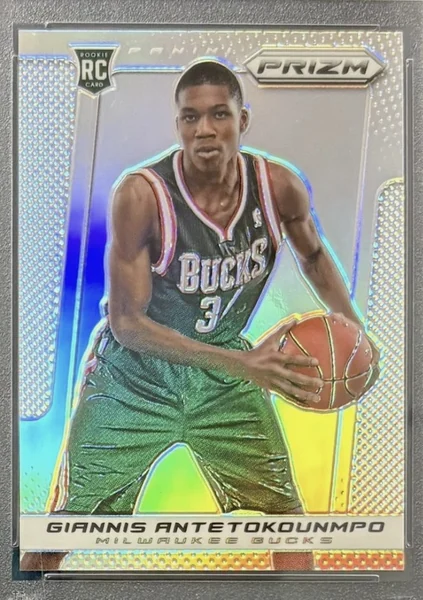
His 2013–14 Panini Prizm card, number 290, is the one collectors treat as his beginning, and the version that matters is the Silver, the mirrored chrome parallel that Panini ran through the packs. Prizm was in only its second basketball season and had not yet become the hobby’s default; it did so in step with that rookie class, and he is the reason the set is remembered. It is a picture of a boy whose name the league had not yet learned to pronounce, in a set that had not yet become the standard. The card is the record of the moment before both changed.
He is not, by temperament, a man who leaves. He gave a city that had not celebrated a title since 1971 a parade. Most stars of his era changed teams to get a ring. He got his by staying, and when he finally went, the city he left was the one holding the trophy. A boy who once laid out watches on a sidewalk in Sepolia would understand what it means to hand people something they get to keep.