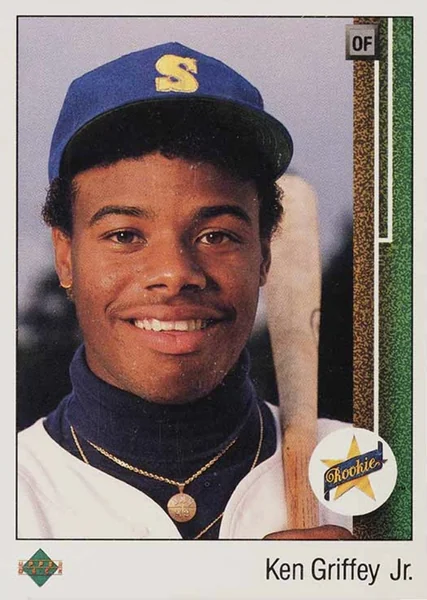
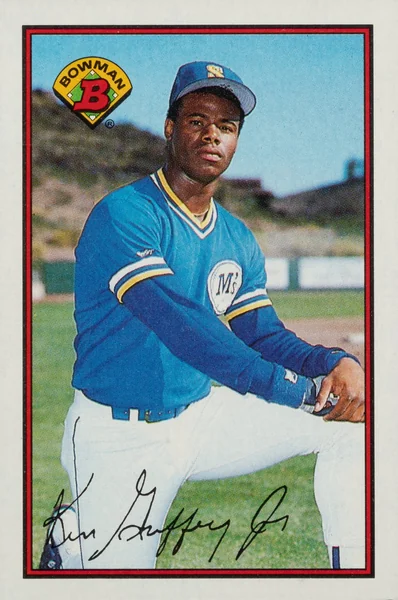
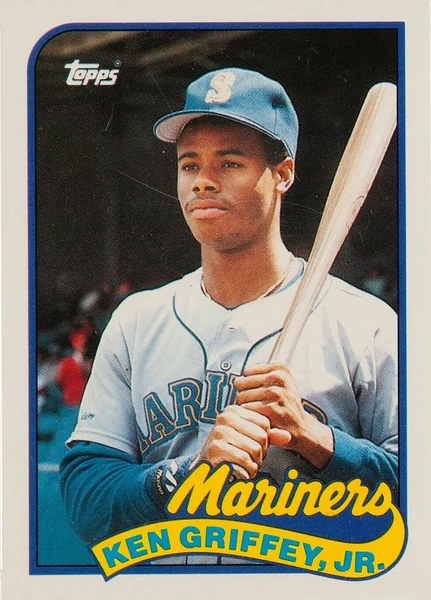
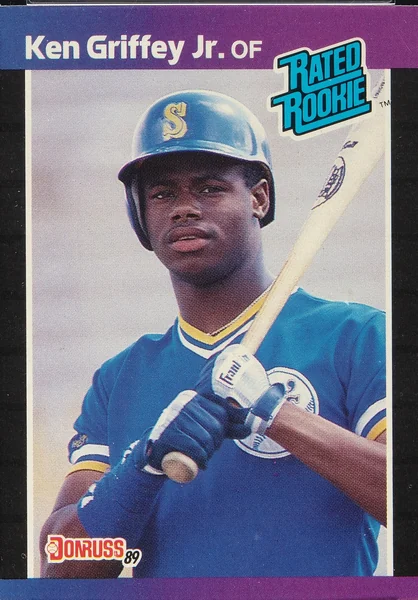
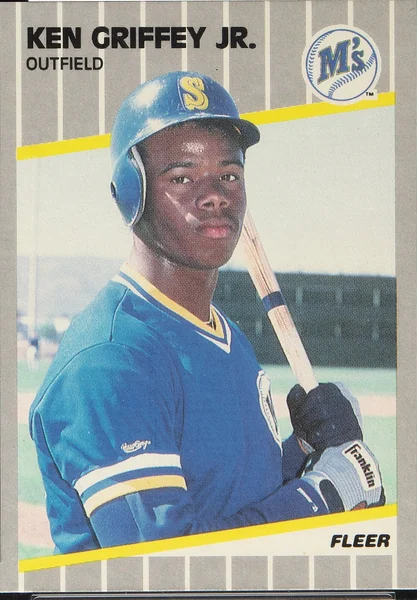
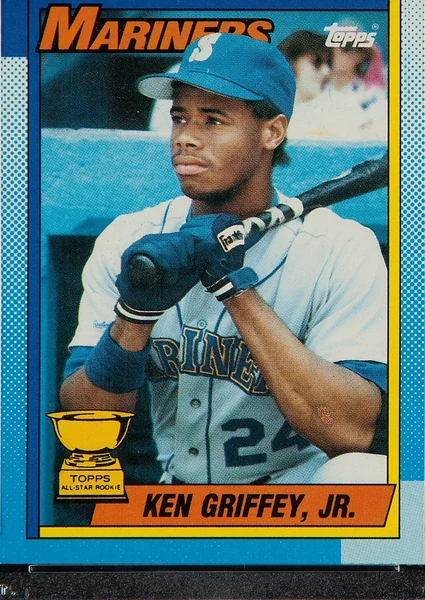
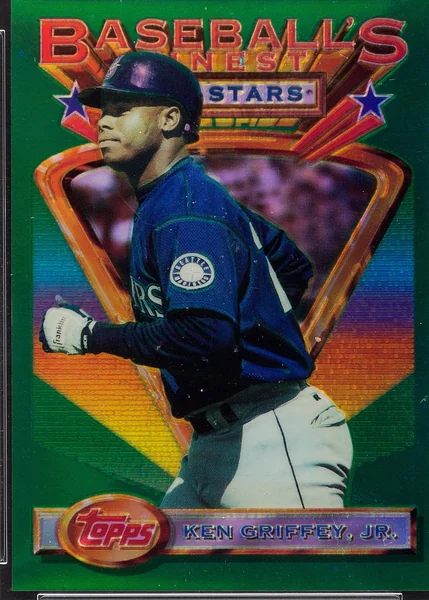
Card #1 in the first Upper Deck set is Ken Griffey Jr., chosen for the spot in late 1988, before he had played above Double-A.
The choice was made by Tom Geideman, eighteen years old and the company’s first employee, who set the order of the Star Rookies at the front of the set. He put Griffey ahead of Gregg Jefferies, Sandy Alomar Jr. and Gary Sheffield, and said later that nobody really knew who Griffey was. John Smoltz is #17 and Randy Johnson #25.
The photograph was taken in San Bernardino by V.J. Lovero, with Griffey in the uniform of the minor-league Spirit. Upper Deck changed it on a Scitex machine, recoloring the cap to Mariners blue, turning the S from silver to yellow and removing a star, and left the navy turtleneck alone. He smiles, a bat on his shoulder and a gold chain at his neck, beside the Upper Deck Rookie emblem, with OF in the corner and his name in the white border below.
Chosen by an eighteen-year-old, before Griffey had played above Double-A.
The hobby counts Upper Deck as the first of the super-premium brands: white stock, color on both sides, no gum, tamper-resistant foil packs of fifteen, and a hologram on the back of every card to defeat counterfeiters. The set ran to 800 cards, the low series early in 1989 and the high numbers in October. The back of #1 has a second photograph, his minor-league statistics and a short biography. The print run was never disclosed; estimates for the Griffey run past two million.
Seattle had drafted him first overall in 1987. He made his debut on April 3, 1989, against Oakland, and hit .264 with 16 home runs. He finished with 630, won ten Gold Gloves, and was elected to the Hall of Fame in 2016 on 437 of 440 ballots.
Card #1 sat at the top left of each 100-card sheet, which left many copies off-center or with a dinged corner; Upper Deck sent replacements to collectors who complained. Print dots and a misplaced hologram are the other faults to look for.