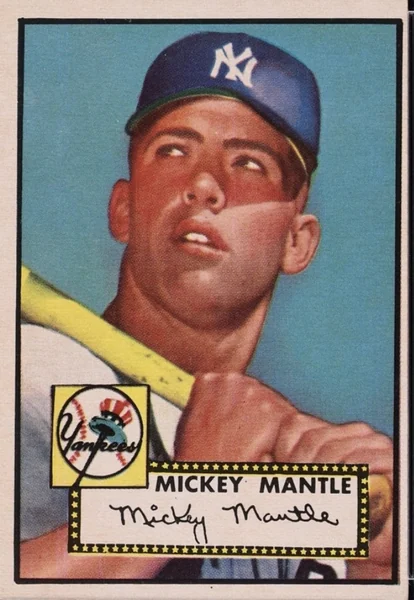
If the hobby has a single card at its center — the one every other grail is measured against — this is it. Not because it is the rarest, and not because it is the oldest, but because it is the one that made the modern hobby a hobby at all.
First, a clarification a serious collector will appreciate: this is not Mantle's rookie card. That distinction belongs to his 1951 Bowman, which arrived a year earlier. The 1952 Topps is something different and, by most measures, something greater — the card that became the symbol of the entire pursuit. It opened the high-number sixth series of Topps' landmark 1952 set, the first full set the company ever made, designed by a young Sy Berger to be bigger and bolder than anything that came before. Card number 311 led that final series, and Mantle's colorized portrait — adapted from a spring-training photograph — became the face of the set and, eventually, of the hobby itself.
It is not the rarest card, nor the oldest. It is simply the one the whole hobby agreed to build itself around.
Its scarcity is a quirk of bad timing. Topps released that high-number series late in the summer of 1952, after the public's attention had already drifted from baseball toward football, and sales were a disappointment. Cases of unsold cards — Mantles among them — sat in a Brooklyn warehouse for years. Hobby lore holds that Berger eventually had the surplus loaded onto a barge and dumped into the river to clear space; whether the tale is literal history or the hobby's favorite campfire story, the underlying truth is the same: this card was overlooked and discarded in its own time, and comparatively few high-grade examples survived. The thing nobody wanted in 1952 became the thing everybody wants now.
That reversal is the whole romance of it. When the hobby's first great boom arrived in the 1970s, it was this card that led the way — collectors placing newspaper ads seeking the '52 Mantle specifically, as though it stood in a class entirely its own. It has been called the Mona Lisa of cardboard, and the comparison is apt: a singular object that long ago stopped being about the man on the front and became about what it represents. The finest examples reside in the most rarefied tier in all of collecting. But every copy, in every grade, carries the same distinction — it is the cornerstone, the card the whole house was built upon.
There is one last wrinkle the deepest collectors prize, hidden in plain sight. Because 1952 Topps was printed on sheets of a hundred cards and the final series held fewer than a hundred designs, a handful — Mantle's among them — were double-printed to fill the sheet. In an era before digital art, that second version had to be recreated by hand, cut and pasted device by device, and it left two subtly different Mantles behind: the ones collectors now call Type 1 and Type 2. The surest tell is on the reverse, where the stitching of the baseball opens to the left on the Type 1 and to the right on the Type 2; the front carries its own faint differences in the black borders around the name and team boxes. Neither grading service officially recognizes the distinction, and to the casual eye the two are identical — which is exactly why collectors who chase one over the other wear it as a quiet badge of how deep they've gone.