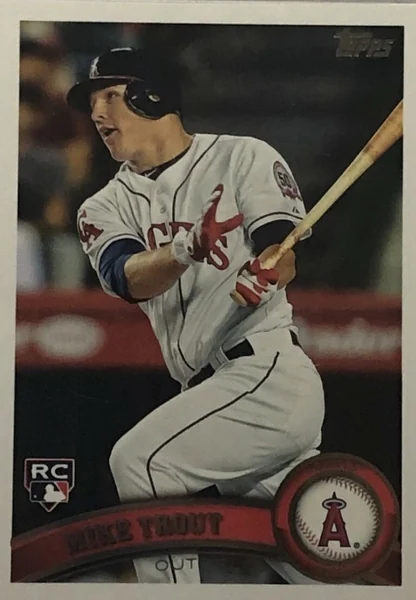
Topps sold its flagship baseball set in three parts in 2011, and the third part was the sweep-up. Series 1 came in the winter, Series 2 in the early summer, and the Update Series in October: 330 cards numbered US1 through US330, holding the players who had changed teams, the All-Star Game, the season’s highlights, and 55 rookies who had not been major leaguers when the earlier checklists closed. It is the only place a July call-up could get a flagship card in the year it happened. Mike Trout is US175, one number among 330, with nothing on the front to say it would be looked at differently from US174.
The year had a theme. 2011 was the sixtieth year of Topps baseball cards, counting from 1951, and the company called it the Diamond Anniversary and dressed the whole run in it: a Platinum Diamond parallel with a sparkle pattern pressed across the surface at one in four packs, a Cognac Diamond for the hobby shops, a Hope Diamond numbered to 60, Gold to 2,011 and Black to 60, and red borders at Target and blue at Walmart. No actual diamonds were involved. Underneath all of that sat the base card, white-bordered and glossy, drawing no attention to itself at all.
One number among 330, with nothing on the front to say it would be looked at differently.
It began with an injury to someone else. Peter Bourjos, the Angels’ center fielder, went down in the first week of July, and on July 8, 2011, Trout, nineteen years old, was in the lineup at Angel Stadium against Seattle: three at-bats, no hits. The next night he bunted, Michael Pineda threw the ball away, and he had his first. He finished the year with 40 games, a .220 average and 5 home runs, which is what the back of this card had to work with. Topps printed it before anyone knew. The following year he hit 30 home runs, stole 49 bases and was the unanimous Rookie of the Year, and the card stopped being ordinary without changing at all.
He had earlier cards. The 2009 Bowman Chrome Draft autograph shows him at seventeen in an Angels uniform, and the parallels above carry tinted and numbered versions of this same photograph. Collectors settled on the plain one anyway, and the reason is not romantic: it is the first Topps flagship card with the rookie logo, from the set every person in the hobby opens, made in a quantity that put one in the hands of everyone who wanted it. Scarcity is what makes most cards the one. Here it was the opposite. A reference has to be common to be a reference.
What the quantity does not supply is a clean example. Flagship Topps is cut from large sheets at speed, and the white border makes any drift in the cut visible at arm’s length, left and right more often than top and bottom. The gloss records the press: fine print lines, roller marks, a speck of stray ink where the background is lightest. Corners soften in the pack before anyone touches them. The uncommon thing is not the card but a copy of it on which the cutter and the press both behaved, and the ones that came out square are the ones that get kept in the dark.