On the night of July 14, 2026, at Citizens Bank Park in Philadelphia, Mike Trout was introduced as the leadoff hitter and center fielder for the American League. He was 34, and it was the first All-Star Game he had been able to play in since 2019; he had been chosen for three in between and missed all three hurt. Millville, New Jersey, where he grew up, is about 40 miles down the road, and he skipped the Home Run Derby to spend the extra days at home with his wife and two sons. He had waited seven years for it.
The Angels took him 25th overall in 2009, one pick after they had taken another outfielder, Randal Grichuk, which is to say that every team in baseball passed on him, including his own. He was in the majors by July 2011, at nineteen, and hit .220 in 40 games. In 2012 he hit 30 home runs, stole 49 bases, scored 129 runs, and was the unanimous Rookie of the Year, and the argument about the best player in the sport was over for the rest of the decade. He won the Most Valuable Player award in 2014, 2016 and 2019, and finished second four other times. Twelve All-Star selections. And a single trip to the postseason, in 2014, three games long, a sweep by Kansas City.
Every team in baseball passed on him, including his own.
That absence is the strange fact of the career. He signed a contract in March 2019 that ran through 2030, and the Angels did not reach October again in any season through 2026. The other strange fact is the body. A torn thumb ligament in 2017, a torn calf in 2021, a broken hamate bone in 2023, and in 2024 a torn meniscus in the left knee, repaired in May and torn again before he could get back, 29 games in all. In 2025 he moved to right field and then mostly to designated hitter, played through a bruise on the same knee, and in September, in Denver, hit his 400th home run, all of them for the same club, 485 feet into the Colorado night.
Then 2026, in its way the more remarkable season: back in center field, in the lineup nearly every day until a hamstring took him out in mid-June, back in early July, the All-Star start in Philadelphia, and by September a second straight year of well over a hundred games, which for him had become the measure. The 425th home run came against Washington on September 11. Nothing about it was dramatic, which was the point.
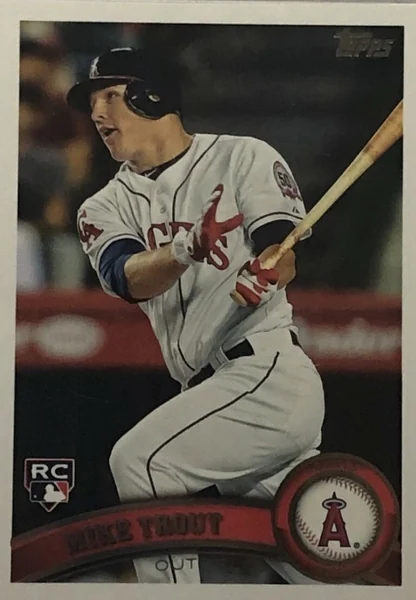
His 2011 Topps Update card, number US175, is his rookie card by general agreement, and it has a quality the scarcer things do not. The Update Series is the fall issue, where Topps puts the players who arrived after the season’s first two checklists were locked, and in 2011 that meant a nineteen-year-old called up in July who had not yet done anything. It was Topps’s sixtieth year, and the set carried the diamond-themed parallels of that anniversary, but the base card is the one that matters: an ordinary flagship card of a boy from South Jersey, printed in quantity, before the argument started. It is the last card of him that nobody had to think about.
He has said more than once that he wants to win, and only in Anaheim. He was never quite the face of the sport he was the best player in, partly because he did not want to be. The numbers will get him to Cooperstown. What they will not convey is how ordinary he made it look, year after year, with almost nobody watching.