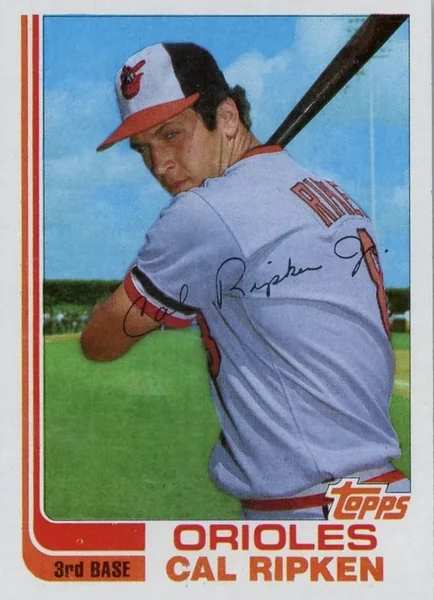
Cal Ripken Jr.'s first Topps card to himself is #98T in the 1982 Traded set, which was sold only as a boxed factory set to hobby dealers.
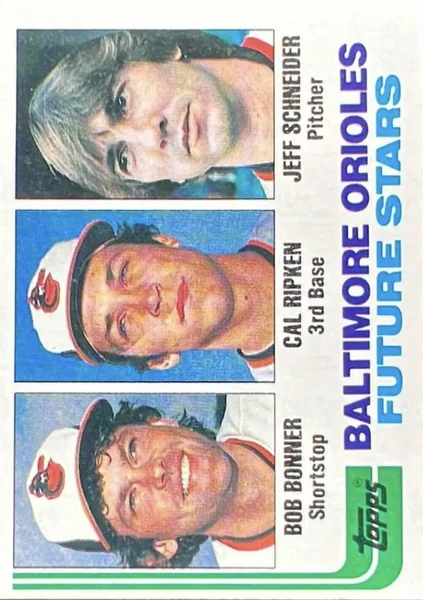
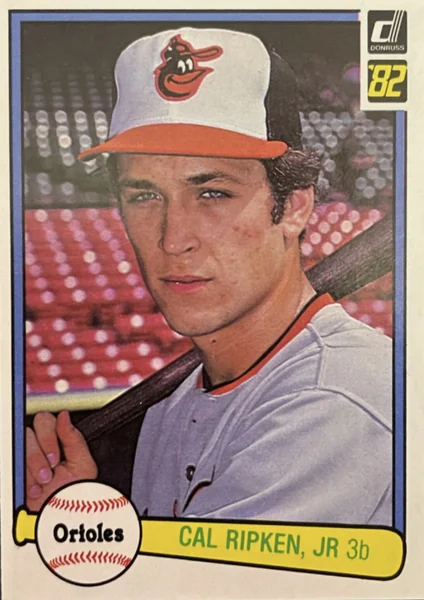
Earlier that year he had shared a Future Stars card in the regular Topps set, #21, with Bob Bonner and Jeff Schneider. Donruss and Fleer also gave him 1982 cards, and those three are the ones the hobby counts as his rookie cards. The Traded card is a fourth, the one collectors know as his first solo Topps.
Topps issued the Traded set late in the season: 132 cards, 1T to 132T in alphabetical order, a hundred sets to a case, never in wax packs. Every photograph was new. A hundred and twelve players appeared in new uniforms, eleven young players were promoted from Future Stars cards to cards of their own, and eight were new to Topps that year. The design matched the regular set, with red backs instead of green. Reggie Jackson is there as an Angel and Ozzie Smith as a Cardinal.
The card says third base. By July he was the shortstop.
Ripken stands in the Orioles’ road gray with the cartoon bird on his cap, a bat on his shoulder, looking back toward the camera with the outfield and a blue sky behind him. His facsimile signature runs across the photograph, and the orange and red stripes of the 1982 design sweep down the left side to ORIOLES and CAL RIPKEN, with a tag that reads 3rd BASE.
He had made his debut in August 1981. On May 30, 1982, he began the streak of consecutive games, and on July 1 he moved to shortstop. He hit 28 home runs, drove in 93 and was the American League’s Rookie of the Year. On September 6, 1995, he played his 2,131st straight game, passing Lou Gehrig, and he did not sit out until September 20, 1998. Two Most Valuable Player awards and nineteen All-Star teams later, he was elected to the Hall of Fame in 2007 with 98.5 percent of the vote.
Because the cards went from factory box to collector, they often turn up cleaner than his pack-issued cards, though centering still separates them.