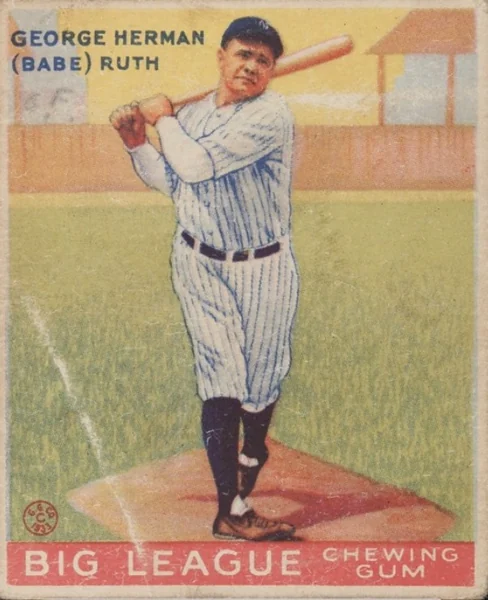
Goudey put Babe Ruth in its 1933 set four times, and #144 is the only one that shows him from head to toe.
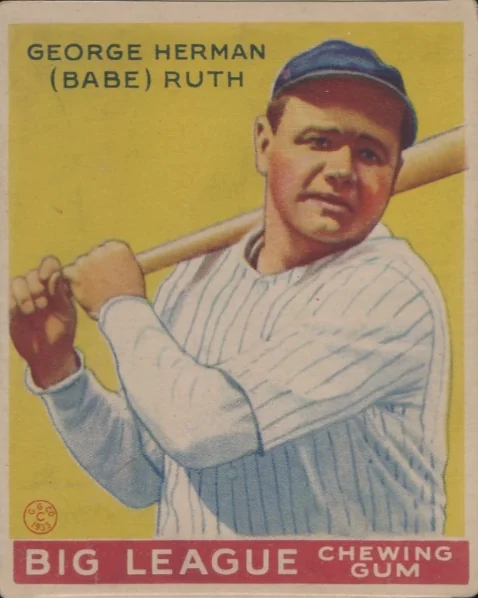
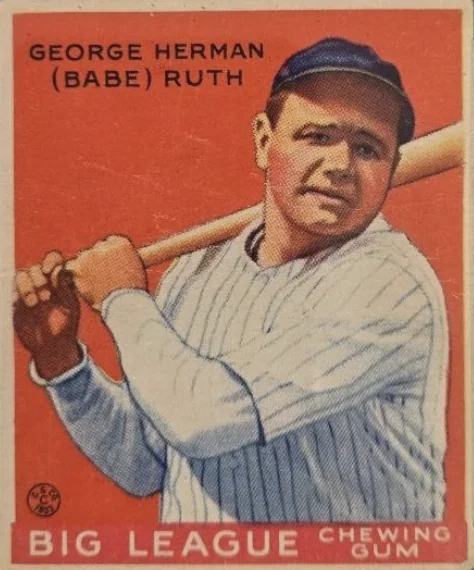
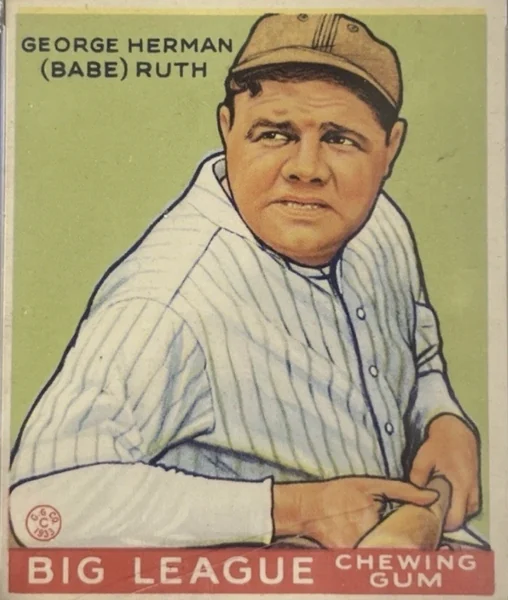
The other three are close in. Numbers 53 and 149 share one portrait, printed once on yellow and once on red; #181 has him seated, looking back over his shoulder, and collectors call it the Green Ruth. Here he stands in Yankee pinstripes on a patch of infield dirt, the bat come all the way around in a follow-through, a yellow sky and a covered grandstand behind him. GEORGE HERMAN (BABE) RUTH is printed across the top in black, and the red banner along the bottom reads BIG LEAGUE CHEWING GUM.
Four Ruths in one set, and only one shows the whole man.
The Goudey Gum Company of Boston sold the cards in penny packs with a slab of gum, releasing them a sheet of 24 at a time through the 1933 season. The backs, in green ink on gray stock, call each card one of a series of 240 Baseball Stars, and the set holds at least forty Hall of Famers. The hobby counts it among the first of the modern gum-card issues.
Only 239 of the 240 went into packs. Number 106, Nap Lajoie, was left out, and collectors who wrote in were later mailed a Lajoie printed in 1934. Many have long believed the omission was deliberate, a way to keep children buying, though Goudey never said so. The Ruth is tied to that empty number: #144 was printed twice on the sixth sheet, once in the space #106 would have taken, which makes it the most available of the four.
Ruth was thirty-eight that summer. On July 6, 1933, at Comiskey Park, he hit the first home run in the first All-Star Game, and he finished the season at .301 with 34. Two years later, with the Boston Braves, he hit the last three of his 714 in one afternoon in Pittsburgh, and in 1936 he was elected to the Hall of Fame with its first class.
Cards from 1933 tend to spot with age, and the background colors vary from one printing to the next.