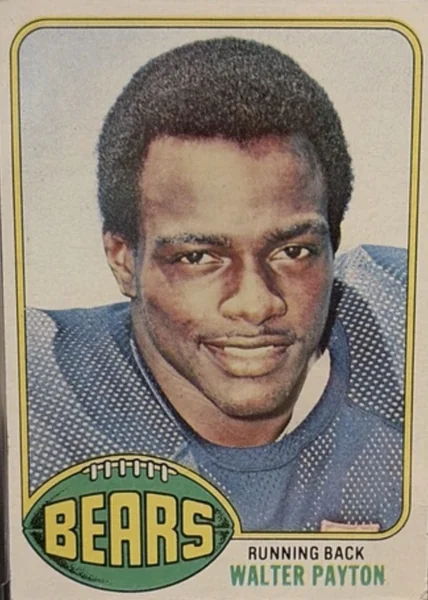
The photograph on card 148 was printed by a company that was not allowed to show the emblem of the team he played for. Topps held no license from NFL Properties in 1976 and had not since 1970; what it had was an agreement with the players’ association, which covered the man and his number and nothing the league owned. So the helmets across the set are painted over, and the team name sits inside that small football because there was no crest it could lawfully sit beside. The alternative that year was Fleer, which held the league’s marks and none of the players, and sold action cards of men it could not name. A collector in 1976 could have the crest or the name, not both. Topps had the name, and the name on 148 was Walter Payton.
He had been the fourth pick of the 1975 draft, out of Jackson State, and his first professional afternoon produced eight carries and no yards. The card went to press with that rookie season on its back, 679 yards and seven touchdowns, along with the first clue in the set’s Guess the Mystery Bear puzzle, a trivia device Topps threaded through each team’s cards that year. Then the 1976 season played out over the months the packs were selling, and it was the one that settled the question. He carried 311 times for 1,390 yards and 13 touchdowns, led the NFC in rushing, and went to the first of his nine Pro Bowls, on a Bears team that finished 7–7 under Jack Pardee.
A collector in 1976 could have the crest or the name, not both. Topps had the name.
The set is a single series of 528, sold in 10-card wax packs for 15 cents, 18-card cellos for a quarter, 42-card racks for 49 cents, and 500-card vending boxes for the dealers. Record Breakers open it at 1 through 8, the league leaders sit at 201 through 206, three playoff cards at 331 through 333, and the team checklists run 451 through 478, also offered by mail on thinner stock. It is the first Topps football set with the Seattle Seahawks and Tampa Bay Buccaneers in it, and it is unusually rich in first cards: Jack Lambert at 220, Randy White at 158, Ed Jones at 427, Ron Jaworski at 426, Randy Gradishar at 257. One quirk belongs to Chicago alone. The football that carries the word Bears is printed in green and gold, the colors of Green Bay.
The backs are the connoisseur’s trouble. The card number sits inside a small helmet, the statistics run horizontal, and the back was cut with less care than the front: a Payton whose face sits square in its borders will often show a 70/30 or 60/40 back, and the grading services measure both sides. Cards that fell near the sheet edges drifted more than the rest. Beyond the cut, the 1976 print carries marks in the color, and the stock rounds at the corners under ordinary handling, as most of these cards received.
What remains is a card that knows less than we do. Its front cannot show his team’s crest; its back stops at 679 yards. It was printed in the last autumn when Walter Payton could be described briefly.