On the morning of November 20, 1977, Walter Payton had a fever of 101 and had spent most of the week in bed. He played anyway, against Minnesota at Soldier Field, in a game the Bears won 10–7. He carried the ball 40 times. He gained 275 yards, more than anyone had gained in a single game in the history of the league, and the mark stood until 2000. He was in his third season. By the end of it he had 1,852 rushing yards and the Most Valuable Player award, and the league had a clear idea of what it was looking at.
He came from Columbia, Mississippi, by way of Jackson State, where he scored 464 points in four years, a college record at the time, and where the nickname Sweetness attached itself, for the way he ran and the way he was. Chicago took him fourth overall in 1975. In his first game as a professional he carried eight times for no yards. He missed one game that season with an injury and did not miss another in thirteen years, which in that job deserves a moment’s pause.
Eight carries, no yards, in his first game. He did not miss another for thirteen years.
The record he is known for is the rushing yardage, 16,726 of it, past Jim Brown on October 7, 1984, and the most anyone had gained when he retired after 1987; Emmitt Smith went by it in October 2002. But the total describes a fraction of him. He caught 492 passes. He threw eight touchdown passes himself. He blocked, and he ran in a way that was his own: he did not step out of bounds, he went into the tackler first, on the theory that the man about to hit him should not get the easier end of it. The off-season conditioning was a steep hill on a landfill in Arlington Heights, Illinois, that he ran in summer, over broken glass, and that is now part of a golf course.
The championship came late. The 1985 Bears lost one game all year and beat New England 46–10 in Super Bowl XX on January 26, 1986, in New Orleans. Payton carried 22 times for 61 yards and did not score; the touchdown from the one-yard line went to William Perry, a defensive tackle, and it is the one thing about that afternoon Chicago regrets.
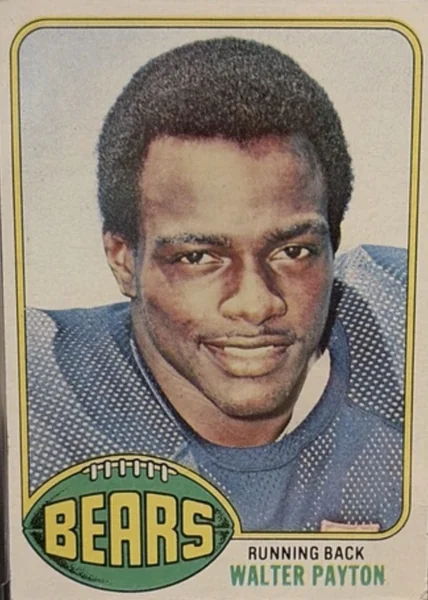
His 1976 Topps card, number 148, is his only rookie card, which is uncommon for a player of his rank and keeps the collector’s task simple. The 1976 set is 528 cards, white-bordered, with a large photograph, the team name printed inside a small football at the lower left, and no team logos anywhere. The backs are orange and blue on gray stock. He is smiling in the picture, which anyone who played against him would have found misleading. The set is not hard to find, but the centering wanders, left to right especially, and a copy that sits square in its borders is the difficult thing.
In February 1999 he announced that he had primary sclerosing cholangitis, a rare disease of the bile ducts, and needed a liver transplant. Cancer in the ducts had spread beyond the liver, which ruled the transplant out, and he died on November 1, 1999, at his home in the Chicago suburbs, at 45. He spent the months he had asking people to register as organ donors, and many did. The league put his name on its award for community service before the year was out; he had won it himself in 1977, the season of the 275 yards. It is the rare trophy where the name explains the award.