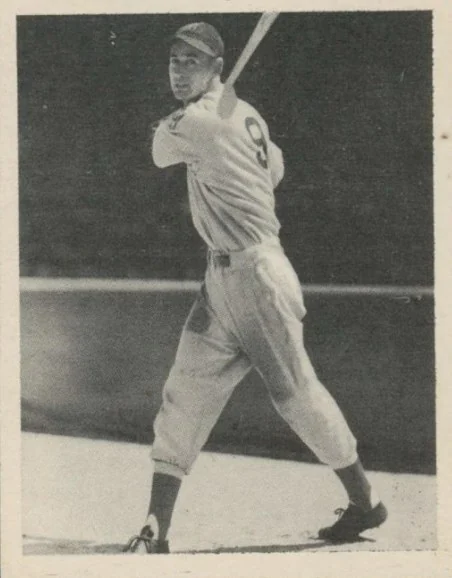
Ted Williams wanted one thing said of him when he was gone: that here goes the greatest hitter who ever lived. He spent forty years at the plate, and the rest of his life away from it, making the claim impossible to wave off. No one in the modern game has matched it, and the way he built it is part of why his cards still carry such weight.
In 1941 he hit .406, and the manner of it tells you everything. Entering the season's final day he stood at .39955 — a number that rounds, mercifully, up to .400. His manager offered to sit him; the record was already his on paper. Williams played both ends of the doubleheader, went six for eight, and finished at .406 rather than accept a championship he hadn't earned outright. More than eighty years later, no one has hit .400 since. It remains one of the most quietly defiant acts in the history of American sport.
He treated hitting as a science when the rest of baseball treated it as instinct. He studied pitchers and mapped the strike zone into a grid of batting averages, and he would not swing at a ball an inch off his sweet spot even with the count full. The numbers that came out of that obsession still stand at the summit: a .344 lifetime average, 521 home runs, two Triple Crowns, six batting titles, and the highest on-base percentage in the history of the game.
He gave five of his best summers to two wars — and still owns the highest on-base percentage baseball has ever recorded.
And those numbers come with an asterisk that runs the other way. Williams lost most of three seasons to the Second World War and the better part of two more to Korea, where he flew combat missions as a Marine aviator, more than once as John Glenn's wingman. Roughly five prime years — the years a hitter banks his counting stats — were spent in a cockpit instead of a batter's box. The totals that already crown him were assembled in a shortened career. What he might have done with those summers is the great unanswerable of the sport.
He was not always easy. He feuded with the Boston writers, refused for years to tip his cap, and wore his pride like armor. But the years tend to burn off the friction and leave only the greatness. When he homered in his final at-bat at Fenway in 1960, the crowd stood and begged him to step out for one last tip of the cap — and he would not. Watching from the stands, the novelist John Updike caught the moment in a line that has outlived the grievance: gods, he wrote, do not answer letters. Williams would not answer the crowd that day, and the refusal has since aged from coldness into legend. What remains now is reverence.
A Williams card holds the purest version of a craft. Other hitters were more beloved in their day, more decorated, more at ease in the light. None of them gave back what he gave back and still hit like that. His cards are not relics of a stat line. They are the testament of a man who decided, against the evidence of every other career, that hitting a baseball could be perfected — and very nearly proved it.