A Card That Existed Only in Theory
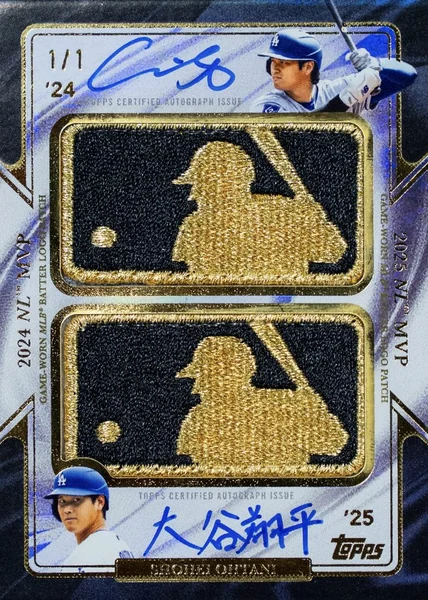
2026 Topps Chrome Baseball landed on July 22, the release the hobby circles on its calendar every summer. Every Chrome year has its chase — a refractor, a rookie, a short print everyone rips boxes hoping to find. This year the chase was a card nobody could yet prove existed: a back-to-back Dual Gold Logoman of Shohei Ohtani, made in a quantity of exactly one.
On July 30, at a shop called Boca Sports Cards in Boca Raton, Florida, somebody opened a box and found it.
Two Nights, Two Patches
A Logoman is the small embroidered MLB silhouette stitched to the front of a game jersey — and because a uniform carries only one, a Logoman card is a literal piece of a specific shirt on a specific night. This card carries two, one from each of Ohtani’s back-to-back Most Valuable Player seasons. The first was worn on April 26, 2024, a home run at Dodger Stadium. The second on September 7, 2025, the night he hit his forty-seventh and forty-eighth of a fifty-five-homer year. Topps set them side by side, each authenticated to its game — one season answering the next.
Both His Names
Then it is signed. Not once but twice: once in English, the way most of his cards carry his name, and once in the Kanji — 大谷翔平 — that appears on almost none of them. That second signature is the detail we keep returning to. It is the small, human thing inside an object otherwise built for spectacle: the same hand, writing itself two ways, for the two countries that have claimed him. A card can hold game-worn cloth and a printing-press pedigree and still, in the end, come down to a man signing his own name.
What Sold, and What We Can Show
Within a day it was gone. A group of collectors in Hong Kong had posted a standing offer of ten million dollars, intending to house the card overseas; an American collector went higher, and the figure reported is eleven million. By public accounting it is the third-largest sum ever paid for a sports card, behind a Jordan-and-Kobe dual Logoman and the 1952 Mantle.
It will not be entering our record, and the reason is worth stating plainly, because it is the whole of what this index is.
The sale was private. There was no auction, no public hammer, no archive anyone can check a year from now. What exists is a number — reported in good faith, very probably exact — and a number is not a record. Everything on these pages comes from a sale we can point at: a date, a lot, an auction house, a link you can follow yourself. That standard costs us something today. It costs us the largest figure of the year. We would rather pay it than write down a price we cannot show you.
And It Does Not Exist Yet
There is one more thing, and it is the part we keep smiling about. What came out of that box in Boca Raton was a redemption — a slip of paper promising a card that has not yet been assembled. The most expensive object in the hobby this year is, at this moment, an IOU.
It will be made. The patches are real, the signatures are real, the man is still playing. But for now the card sits where we put it before any of this happened: in the Vault, our reverent wing for the grails that almost never trade, beside a Wagner, a Jordan-and-Kobe dual Logoman, and Ohtani’s own 2024 Dynasty Black. We placed it there when it was only an idea, on the grounds that some cards are made to be kept rather than priced.
Eleven million dollars later, we see no reason to move it.