
A radio for a jersey
This is a weekly letter about the high-end of the card market, and this week it is mostly not about cards. Three objects changed hands over the summer, none of them bought by their original owners as any kind of investment: a jersey, a jacket and a card. Setting the three side by side turns out to be instructive. We will start with the jersey, because its story is the oldest.
In the mid-1970s a teenager in South Gate, California had a routine: take the bus to the Forum in Inglewood with friends, work the crowd outside for a spare ticket, watch the Lakers, then wait in the parking lot afterward for the players to come out. He walked Wilt Chamberlain to his car once. Mostly the kids out there traded things with each other.
One night another boy had a UCLA jersey with him, No. 33, hoping to get it signed. The boy holding it was a USC fan, which made the negotiation short. What went the other way was a transistor radio — the one its owner had been listening to Dodger games on, under his pillow.
He kept the jersey for roughly fifty years. Folded away, mostly; taken out now and then to show somebody. This year he was clearing things out and decided someone else would get more from it than a storage bin was getting. He gave his first name, David, and asked that the rest be left off.
He did not know what he had. Photo-matching found it. Alcindor wore that jersey scoring 34 points and taking 16 rebounds in UCLA’s 78–55 win over North Carolina for the 1968 championship, and again the following season, including an 85–82 semifinal against Drake. Two independent photo-match letters came with the lot. It is the only photo-matched Alcindor UCLA game jersey known to exist. When the sale closed on August 16 it realized $1,254,918.
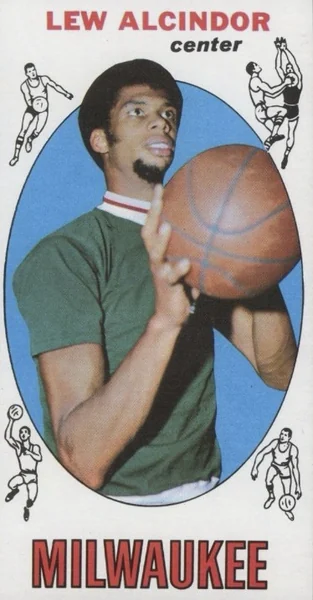
The card that pictures him in those years — before the name change, in his first Topps appearance — is one of the twenty-five at the center of this index.
Three dollars and seven cents
In January a young man named Quinn Brown was going through a bin at a Goodwill outside Portland, Oregon. He resells clothes online, so the bin was work, not browsing. Someone ahead of him looked at a yellow Lakers warm-up jacket with Chamberlain’s name in it and threw it back on the pile. He paid three dollars and seven cents for it.
It turned out to be a jacket Chamberlain wore during the 1972 Finals, the year the Lakers beat the Knicks. It went to auction in July with a published estimate of $150,000 to $250,000, and there was a good deal of writing about the quarter of a million dollars a Portland teenager was about to make.
It sold for $89,600.
That is a wonderful outcome for a three-dollar jacket and it is also, for anyone reading auction previews, worth sitting with. An estimate is a house’s opinion before the fact. A result is what somebody actually paid. The two are not the same number and they are not the same kind of number, and the gap between them is not unusual — it is the ordinary condition of this market. We say the same thing every week about asking prices and sales. It applies with more force to a category where every object is the only one of itself.
Chamberlain’s 1961 Fleer rookie is on our roster. It is a card printed by the thousand, which is precisely why it can be priced at all.
A tag cut out of a jersey
The third object was made on purpose. In 2017 Panini took a laundry tag — the small manufacturer’s label sewn inside a game jersey, the one nobody in the stands ever sees — cut it from a jersey Patrick Mahomes wore as a rookie, set it into a card alongside his signature, and made exactly one.
That card came up at Heritage in the sale that closed on August 23. The published estimate was $400,000, and the coverage around it did what coverage does, which is wonder aloud whether it would land in the top ten football cards ever sold. Mahomes already holds the top spot, from a different National Treasures rookie in 2021.
It sold for $280,600.
Which is the second time in this one letter that a published estimate turned out to be a house’s opinion and the result turned out to be a number. That is not a complaint about anybody. Estimates are useful and houses are not fortune tellers. It is simply the difference between the two, and it seems worth seeing twice in the space of three stories.
What is interesting about the card is not the number anyway. It is the instinct behind it. Somebody worked out that collectors would pay a great deal for a physical piece of a jersey a player actually wore, and then manufactured that feeling in advance rather than waiting fifty years for a photo-match to confirm it. Mahomes’ 2017 Prizm rookie, which contains no part of anything, is the roster card.
A jersey nobody could identify. A jacket somebody threw back on the pile. A tag cut out and sealed in plastic before the player had started a playoff game. The three of them arrived at the same market from completely different directions, and what decided the outcome in every case was not the object. It was whether anyone could prove where it had been.
It is worth putting the two ends of that beside each other. Proof somebody had to go and find, fifty years late, on a jersey traded away for a radio: $1,254,918. Proof manufactured on purpose, in advance, and sealed in plastic: $280,600.
That is the part of this hobby a graded card quietly solves. The slab is not just a grade; it is a certificate number, a population, a chain of custody, and a claim any two people can check against each other. It is why one Kareem rookie can be compared to another Kareem rookie at all, and why a jersey — magnificent, singular, worth more than every card on this page — can never be indexed. Proof, standardized in advance, is the whole reason a number like ours can exist. Everything else is a story you have to be able to write down.