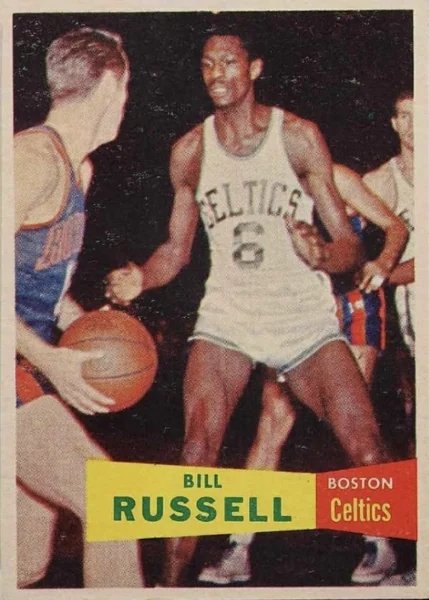
Topps had not made a basketball card since 1957–58, the set with Bill Russell's rookie card in it. In 1968 it tried again, quietly: a set of 22 cards that was printed but, as far as anyone can tell, was never meant to reach the public. The cards that exist came out by side doors, through finds connected to the company's employees and production staff, one of them tied to the son of a Topps executive.
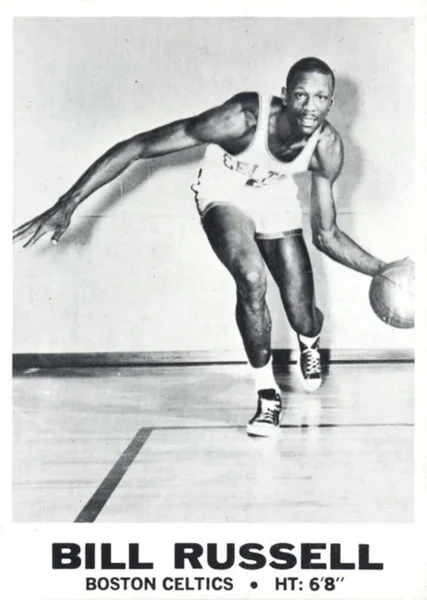
They are as plain as cards get: a black-and-white photograph, taken from team-issued press pictures, on a clean white ground, with the name, team and height in bold black type. Fifteen of the 22 players are now in the Hall of Fame. The backs are pieces of a puzzle, and all 22 together make a picture of Wilt Chamberlain dunking. So the back of the Bill Russell card is a piece of Wilt Chamberlain. On the front of #4, Russell is caught low and leaning in a gym, dribbling, his other arm flung out wide.
Every back is a piece of a puzzle of Wilt Chamberlain. So is this one.
Topps itself counts #4 as Russell's second Topps card, eleven years after the first.
By then he was coaching the team as well as playing for it. The Celtics named him head coach in April 1966, the first Black head coach in NBA history. His first season in the job ended Boston's run of eight straight titles, when Philadelphia beat them in the Eastern Division finals. His second ended with the championship, over the Lakers in six games, his tenth title in twelve years, and Sports Illustrated named him its Sportsman of the Year for 1968.
The scarcity of this card has nothing to do with series or condition. There are very few of them. When a complete set came up at auction in 2010, it was described as the first the house had ever offered.