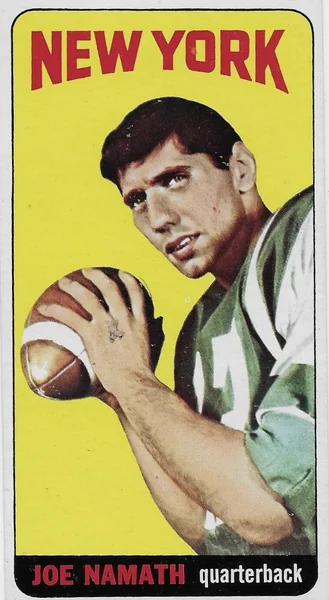
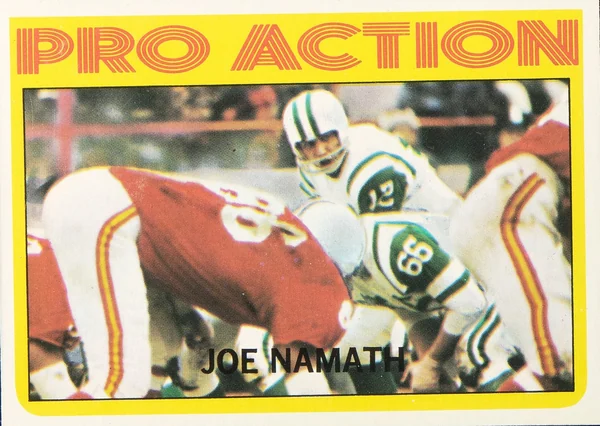
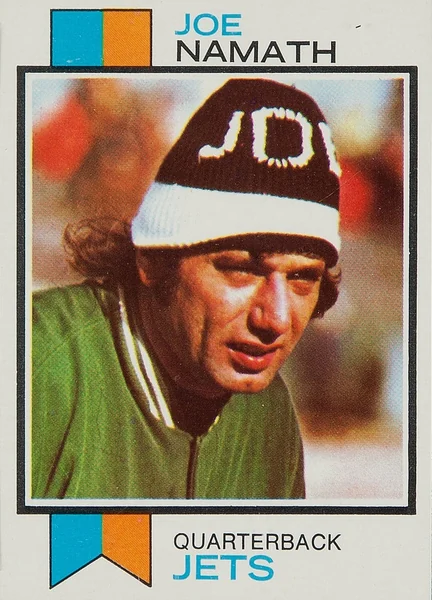
Joe Namath’s rookie card is 4-11/16 inches tall, more than an inch taller than a standard card. It comes from the 1965 Topps football set, which collectors call the tall boys.
Topps held the American Football League’s rights in those years, and Philadelphia Gum held the NFL’s, so the 176 cards are all AFL players, grouped by team, with the teams in order by city. They came in wax and cellophane packs with gum and a Magic Rub-Off. Most of the set, 132 cards, was short-printed, and 44 were double-printed. Namath’s is one of the short prints, sitting between two of the doubles: #121, Don Maynard, and #123.
NEW YORK runs across the top in red over a bright yellow background. Namath, in a green Jets jersey, holds the ball at his chest in both hands, ready to throw, his eyes up and to the side. JOE NAMATH, quarterback, is printed in red and black along the bottom. The back has a cartoon about his 1965 Orange Bowl for Alabama and a paragraph about his signing with the Jets.
More than an inch taller than a standard card, and every bit of it exposed.
He signed on January 2, 1965, in Miami Beach, choosing the Jets over the NFL’s St. Louis Cardinals, for what was reported as the richest rookie contract in any sport. He won the starting job in his third game and was the AFL’s Rookie of the Year. In 1967 he became the first quarterback to throw for more than 4,000 yards in a season. Days before Super Bowl III he guaranteed a win, and on January 12, 1969, the Jets beat Baltimore 16–7. He was elected to the Hall of Fame in 1985.
The length is the trouble. Long cards were hard to store, the corners and edges took the wear, and the thin white border against the bright background shows any shift in centering. Print flaws show more on a card this size.