The year they stopped booing
They booed him. Nobody remembers that now — it does not fit the rest of the story — but they did, for five seasons, in his own ballpark, loudly. He had arrived in 1951 as the nineteen-year-old who was going to be the next DiMaggio, and DiMaggio was still standing in center field at the time, which is a difficult thing to be the next of. He struck out. He got hurt. He got sent down to Kansas City and cried on the phone to his father, who drove up from Commerce, Oklahoma, and started packing his son’s suitcase for him. New York had been promised a legend and had been handed a kid from a lead-mining town who could not stay healthy, and New York let him know about it.
Then 1956 happened.
He hit .353. He hit 52 home runs. He drove in 130. Nobody in either league beat him in any of the three, which is the version of the Triple Crown that almost never happens, and he did it at twenty-four years old. The booing stopped that summer and never came back for the rest of his life.
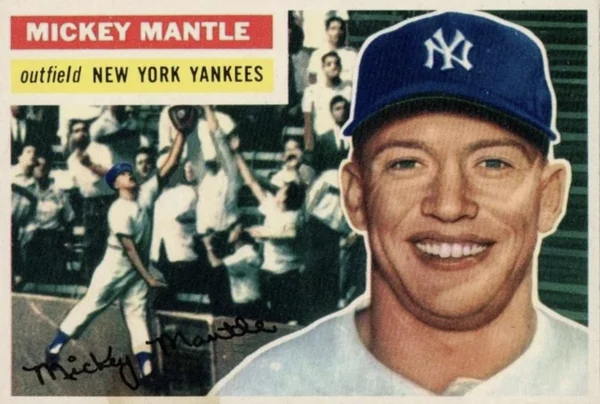
Topps made his card that year the way you would make it if you knew. The big portrait takes up most of the front, and he is grinning like a man who has not yet been told anything is going to be hard. Off to the left, small, is a painted scene of an outfielder at the wall with his glove up and the crowd already on its feet.
Which is worth sitting with for a second, because that October he went out and did it. Game 5 of the World Series, Don Larsen on the mound throwing the only perfect game anybody has ever thrown in October. Mantle hit the home run that won it, 2–0, and in the fifth he ran down a Gil Hodges drive into left-center that would have ended the whole thing. Seventy years later the game is still perfect, and part of the reason is a twenty-four-year-old outfielder running full out with his back to the infield, exactly like the little painting on his own baseball card.
Robert Edward Auctions has that card at the top of its September sale — the gray-back 1956, graded PSA 8.5 — and the whole thing, something over 4,600 lots, closes Sunday night. PSA has graded more than 10,000 of these over the years, and 44 of them sit above this one. That is not a knock on it. That is what it takes to be near the front of a line that long.
We do not follow the 1956, as it happens. The Mantle on our list is the 1952 at PSA 4, and there is a whole other column in why. But if you were ever going to fall for a Mantle card on looks alone, the 1956 is the one that would do it.
Six of ours are in the room
Six of the thirty-nine cards we follow turn up further down the same catalog, and the grade each one came in at is most of the story.
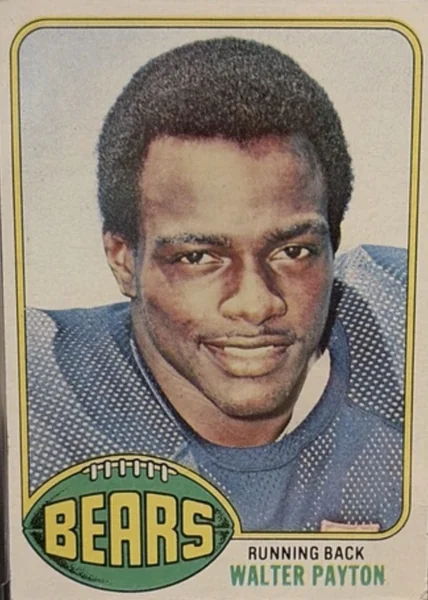
A 1965 Topps Joe Namath rookie at PSA 7.5. A 1957 Topps Bill Russell rookie at PSA 5 — a Russell rookie that has clearly been somewhere, which we like. A 1976 Topps Walter Payton rookie at PSA 9, which happens to be the exact grade we pin that card at. A 1986 Fleer Michael Jordan at PSA 8. And two of ours wearing other people’s holders: a 1958 Topps Jim Brown rookie at SGC 7.5, and a 2000 Bowman Chrome Tom Brady at BGS 9.5.
Everything in that paragraph is an asking price until Sunday. A catalog is a building full of questions, and the answers all arrive in one long evening.
One more, a little further out and worth the detour. Goudey put four different Babe Ruths in its 1933 set, which is four more than most sets manage, and collectors have called them by their backgrounds ever since: the yellow, the red, the green, and the full-body one. Miller & Miller, a small house in Ontario, Canada, closes a collection on the twenty-seventh with two of them in it — the red (#149) and the green (#181). The Ruth we follow is the fourth, #144, the only card in the set that shows him head to toe, so neither of these is on our list of thirty-nine. Go and look anyway. Two of the four in one room is not a thing that happens often.
The man who went looking for something hard
Mantle spent 1956 being the best baseball player alive. Thirty-eight years later the best basketball player alive got in a van and went to Birmingham, Alabama, to be bad at it on purpose.
Sports Illustrated keeps a weekly list of the five biggest card sales, and earlier this month one was led by a 1995 Upper Deck SP Top Prospects Michael Jordan — the one where he is in a Birmingham Barons jersey, signed. It sold through REA on the first of the month for $525,000.
Think about what that card is. He had won three championships. He could have done anything, and what he wanted was to find out whether he could hit a Double-A curveball. He hit .202. He rode the buses. He was, by a considerable distance, the most famous man ever to be mediocre at minor league baseball, and he did it in public for a full season with everybody watching.
A collector paid half a million dollars for the photograph of that. Not the championships, not the jumper that beat Utah in ’98, not the best card of the best player — the summer he was ordinary, with his unmistakable autograph across the front.
Nobody’s life runs point A to point B, and the careers worth telling stories about run the least straight of all. Mantle got booed in his own ballpark for five seasons before the summer that fixed it. Jordan had already won everything and went looking for something he might not be able to do. This hobby will tell you it pays for condition and scarcity, and it does. But the cards we cannot stop looking at are almost never the ones about winning. We know what greatness looks like. We recognize ourselves in the other thing.
Sunday night
A catalog gets about ten days to be interesting. For those ten days the Mantle is a question — somebody has named a number and nobody has answered it. On Sunday, at whatever hour the last bid lands, it becomes a fact with a lot number on it.
Both numbers are worth having, and they answer different questions. What sellers are asking tells you what it costs to own one this afternoon, and that is the number we track every day. What a card actually brought at auction tells you what one person paid, once, at a grade we can name — and those go into the Record, our running ledger of realized results. Sunday’s will not predict the next one. No single sale ever does. It will just be true, which is enough.
The close is Sunday, the twentieth. The Radar, our calendar of what is closing where, has it.
See you next Friday.
— Greg