The one that went in the ocean
Every 1952 Topps Mickey Mantle in the world is a survivor twice over, and the second time was not close.
The story that gets told, and Topps never much disputed it, is that the high numbers did not sell. They shipped late in the season, in the autumn, once the country had turned its attention to football, and the cases came back. They sat in a warehouse for the better part of a decade until somebody decided the space was worth more than the cardboard, and around 1960 the unsold stock was loaded onto a barge and dumped into the Atlantic off the Jersey shore. Card 311 was in there. Thousands of him.
So every one that exists is a card some kid bought for a penny in 1952 and then — this is the improbable part — did not lose, did not trade for a better one, did not put in the spokes of a bicycle.
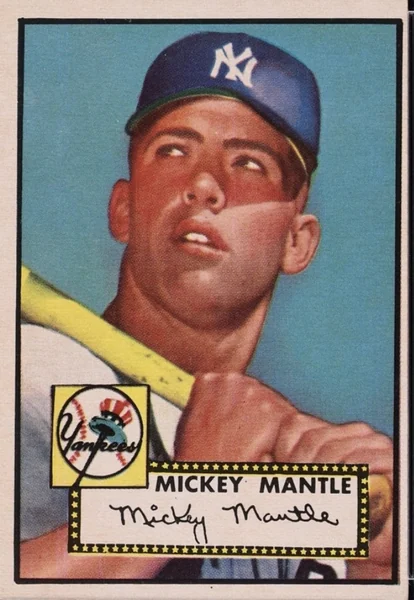
Which is why, when a PSA 3.5 came up in Heritage’s Summer Platinum Night sale in August, the word that came to mind was not damaged. Rounded corners are what happens to a card that lived in a pocket. A soft crease is a card that got looked at. Somewhere under that is a boy who carried Mickey Mantle around with him in the summer of 1952 and could not have told you why it mattered, because it did not yet.
It brought $390,400.
A PSA 8 in the same catalog brought $3,721,000, and that is a magnificent object too — sharp, bright, somehow untouched by seventy-four years. But a high-grade 1952 Mantle is a card that was never really owned. The 3.5 was. Both are worth a great deal of money and only one of them has a childhood in it.
And it was not even the lowest grade in the building. Three days later the same sale offered a 1948 Leaf Jackie Robinson rookie graded PSA 1.5 — a card that has been round the block and looks it — and it brought $24,400. Leaf’s production in 1948 was erratic to the point of shambolic, the set is riddled with short prints, and finding one properly centered is close to a fool’s errand. Nobody who bid on that card was confused about its condition. They were bidding on the first card of the man who changed the sport, in the state the world left it in.
Fifty in the world, and one of them moved
We keep a small room on this site called the Vault, for cards that do not really trade. No prices, nothing to buy, no daily tile — just the objects, because some of them have stopped being a market and become history instead. The T206 Honus Wagner has been in there since the beginning.
Roughly fifty authentic examples are known. The card was pulled from production early, in 1909, reportedly because Wagner himself objected to it, and that act of corporate housekeeping turned a tobacco insert into the most famous piece of cardboard on earth. Nobody was supposed to keep those either.
In August one of them moved. Not just any one: a Wagner with a Piedmont advertising back, one of three known, off the market for something like twenty-five years. It drew fifty-three bids and sold for $5,856,000, and the buyer became only the third person to own it in a hundred and seventeen years.
It arrived with a letter. In 1958 a man named Charles Bray, who published a mimeographed sheet called The Card Collectors Bulletin for a few hundred people who had no idea they were founding anything, wrote about this card. That letter is still with it. Sixty-eight years, three owners, and somebody at every stage thought to keep the piece of paper as well as the card.
And here is the detail we cannot stop enjoying. The Wagner is graded SGC Authentic — which is not a number. It means: this is real, and we are not going to put a score on it.
So the three cards everybody talked about this summer were a 1.5, a 3.5, and one carrying no grade whatsoever. Somewhere past a certain altitude the flip stops being the point. What you are buying is the thing itself, and the improbable fact of it still being here.
Open now, if you would like to watch one
Memory Lane’s Summer Rarities auction opened on Thursday and runs to the twenty-sixth, and four of the thirty-nine cards we follow are in it.
The headline lot is a 1955 Topps Sandy Koufax rookie at PSA 9, which the catalog describes as carrying a gold Mike Baker sticker — a second opinion on how that particular copy presents, offered after the grade is already assigned. It opens at $50,000, which is an asking price and nothing more; where it finishes is anybody’s guess and certainly not ours. Alongside it: a 1954 Topps Hank Aaron rookie at PSA 8, a 1951 Bowman Mantle, a 1953 Topps Mantle, and a deep, unusually good run of Roberto Clemente.
Go and look at it even if you have no intention of bidding. Reading a catalog is one of the cheapest pleasures this hobby offers, and there is no version of it where you come away knowing less than you did.
Kept anyway
None of these things were supposed to last. The Mantles went in the sea. The Wagners were pulled off the line. The Koufax was a rookie card in a wax pack, which is to say it was designed to be handled by a nine-year-old and thrown out by his mother.
Every one that is still here is here because somebody kept it for no particularly good reason, and then somebody else did, and so on down the line until the thing had been carried far enough to become remarkable. That is the entire trick. It is why a creased card can be worth $390,400 and why a letter from 1958 travels with a Wagner. Somebody bothered.
See you next Friday.