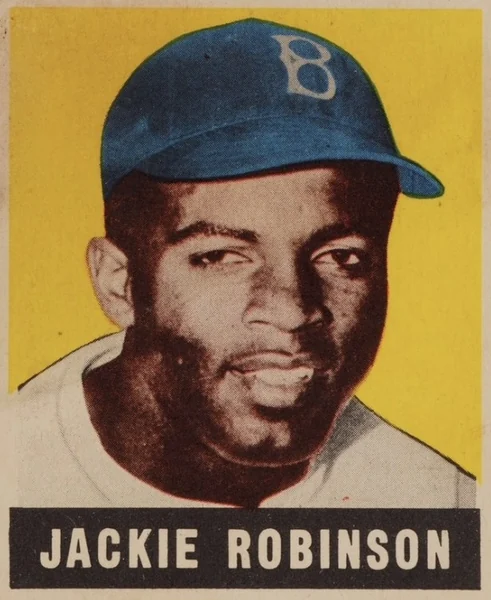
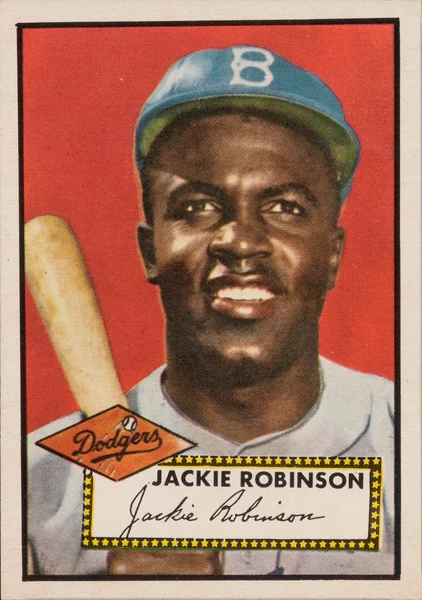
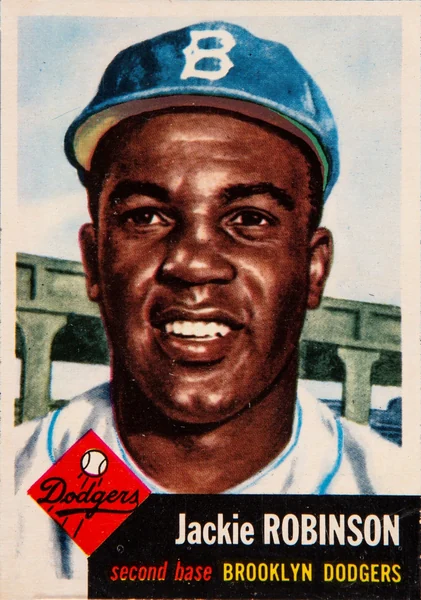
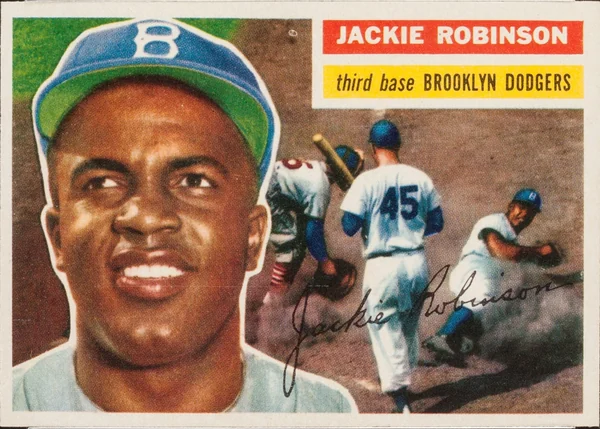
Jackie Robinson’s rookie card comes from the first baseball set printed in color after the war, the one collectors call 1948 Leaf.
The name is slightly early. Some of the cards carry a 1948 copyright and some 1949, and the evidence points to most of them reaching stores in early 1949. By then Robinson had played two seasons in Brooklyn under a promise he made Branch Rickey in August 1945, that there would be no incident. He kept it through 1947 and 1948. Before the 1949 season Rickey released him from it.
The card is a close portrait. He looks straight out under a blue Dodgers cap with the B, against a flat yellow background, and JACKIE ROBINSON runs in white capitals across a black box at the bottom. The images in the set were colorized by hand, and Leaf’s printing was rough: colors drift, registration wanders, and PSA singles out this card for its stock and the print flaws in its yellow.
He kept the promise through two seasons. The card came out as it ended.
Leaf, a Chicago gum company, issued 98 cards but numbered them as high as 168, and half of the 98 were short-printed. Robinson is not one of them. The set also holds Joe DiMaggio at #1, Babe Ruth at #3, Stan Musial at #4, Satchel Paige at #8 and Bob Feller’s rookie. The backs end with an advertisement for All-Star Baseball Gum.
In 1947 he was the first Rookie of the Year the full baseball writers’ association voted on. In 1949, free to answer back, he won the batting title at .342, led the league in stolen bases, and was the National League’s Most Valuable Player. He was elected to the Hall of Fame in 1962, and in 1997 his number 42 was retired across the major leagues.
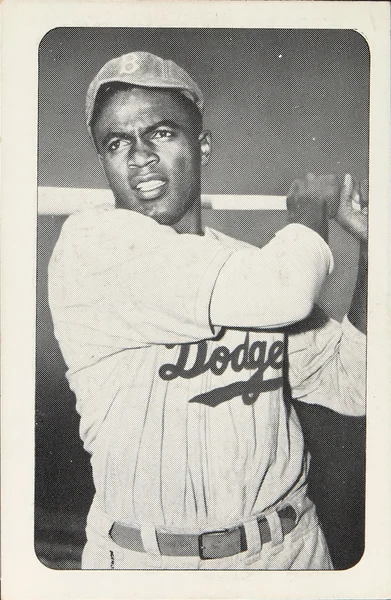
A thirteen-card Bond Bread set of black-and-white photographs came out in 1947, a year before this one. The hobby still treats the Leaf as his rookie card.