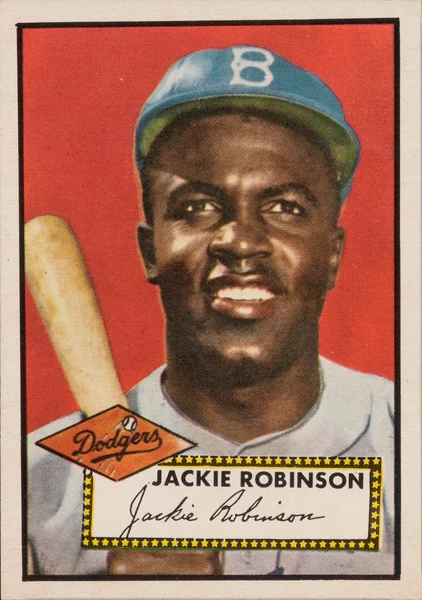
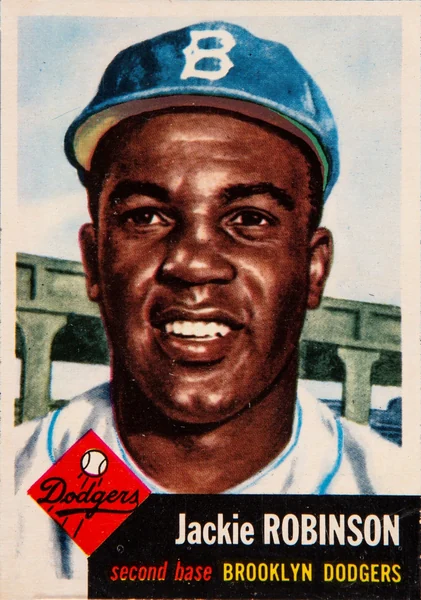
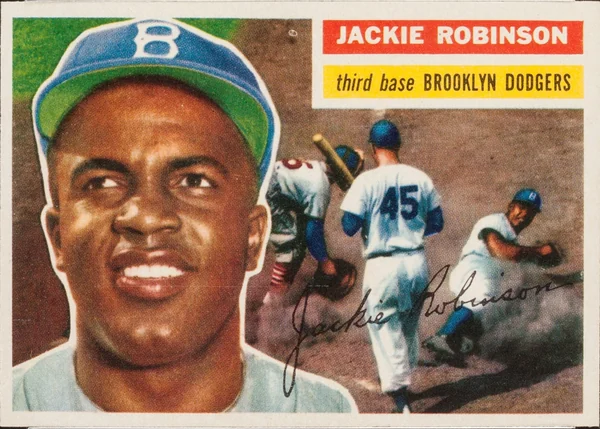
The thing that gets lost is that he could play. Not "could play, considering" — could play, full stop. Jackie Robinson won the Rookie of the Year award in 1947 and the Most Valuable Player award two years later, hitting .342 with a league-leading thirty-seven stolen bases. Over ten seasons he batted .313, reached six World Series, and was named to six consecutive All-Star teams. He had already been a four-sport athlete at UCLA — baseball was reportedly his weakest of the four — and he arrived in Brooklyn at twenty-eight, having lost his best athletic years to the Negro Leagues, the army and the color line itself. What the record shows is a man who was very good rather late, which raises a question about what he might have been that nobody can answer.
He played a style that unsettled people on purpose. He took enormous leads, danced off third, and stole home nineteen times in the regular season, and once more in the 1955 World Series, which is a statistic that sounds like a misprint and is not. Pitchers hated him. Opposing dugouts said things to him that do not bear repeating here, and for his first seasons in Brooklyn, by an agreement he had made with Branch Rickey, he was not permitted to answer any of it. That agreement is the part people tend to skip past. He was not by temperament a quiet man; he was combative, argumentative, thin-skinned about injustice, and he agreed to swallow all of it for two years because the alternative was that the experiment would be blamed on his temper.
He was not, by nature, a patient man. He agreed to be one for two years, which is a harder thing than being born to it.
When the agreement expired he stopped being quiet and never started again. In July 1949, still in a Dodgers uniform, he testified before a committee of Congress. He argued with umpires, criticized the pace of integration in public while it was still costly to do so, and after retiring at thirty-seven he wrote a newspaper column and spent the rest of his life pressing the point that a game with Black players and no Black managers had done half a job. He was, in the phrase of the period, difficult, which in his case meant unwilling to be grateful on schedule.
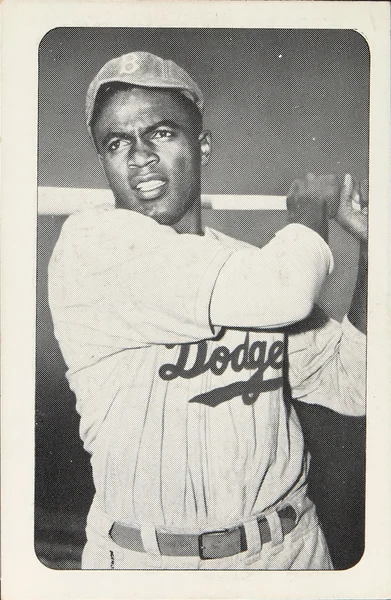
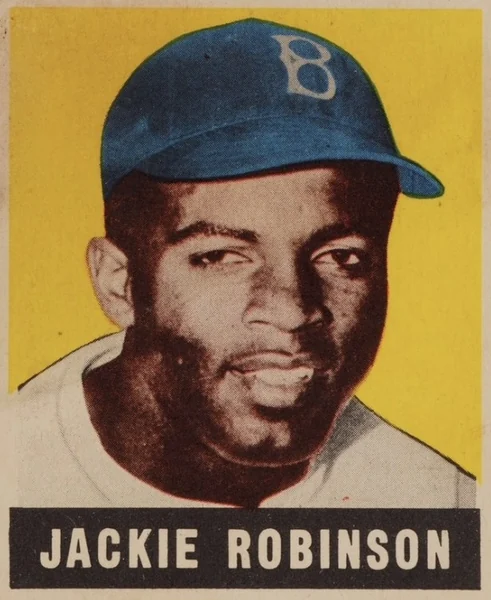
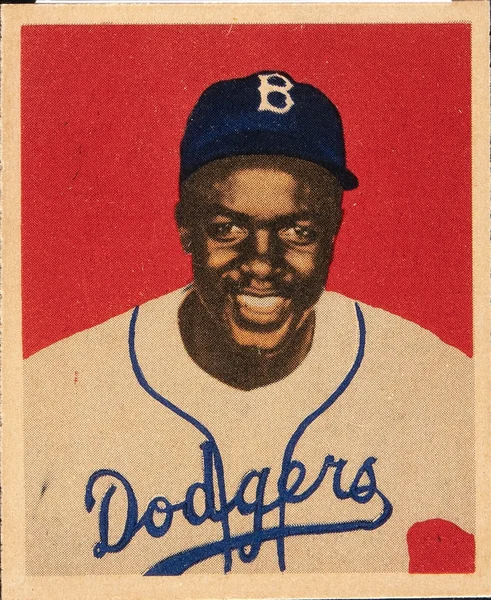
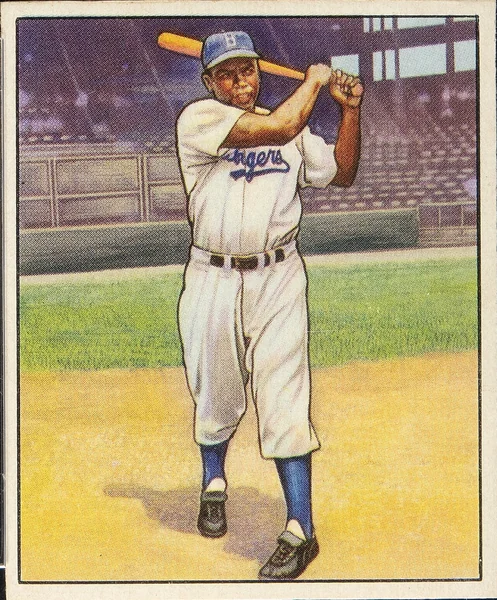
His rookie card is number 79 in the 1948 Leaf set, Robinson against a yellow background, and it is known for poor centering and heavy, uneven ink. That is why so few survive in high grade, and why a well-centered mid-grade example is a real card rather than a compromise. It was not the first card of him: Bond Bread put him on black-and-white cards in 1947, and those have their own page here.
He died in 1972 at fifty-three, having gone nearly blind from diabetes, nine days after throwing out a ceremonial first pitch at which he used the microphone to ask again about managers. Most names in this index are kept for what they did in a uniform. His is kept partly for what he did in one, and partly for what it cost him.