In the spring of 1953 the Dodgers brought up a second baseman named Jim Gilliam, and Charlie Dressen meant to play him. That left the incumbent at second base looking for somewhere to stand. Robinson spent the summer mostly in left field and at third, filling in wherever the lineup had a gap, and hit .329. Gilliam was named Rookie of the Year. Brooklyn won the pennant by thirteen games.
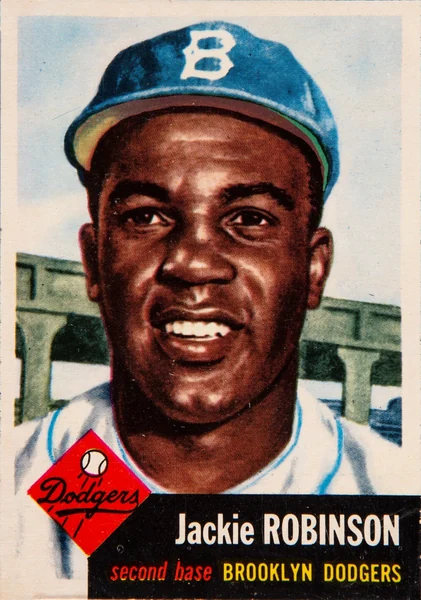
The card does not know any of this. It was made over the winter, from the previous season, and it calls him a second baseman. Topps had decided to open its 1953 set with him, and so he is card number one: a painted portrait, the broad smile under a blue cap, a little bit of ballpark behind him, a red Dodgers diamond in the lower corner and a black panel carrying his name in large type.
Topps opened its 1953 set with him, and so he is card number one.
Every front in the 1953 set was painted, and the paintings are the reason people still talk about it. The set was planned at 280 cards and came out at 274; six numbers in the last series were never printed, and the hobby has since worked out which players were meant to fill them. The cards are the same large 2 5/8 by 3 3/4 inches as the year before.
Being first has a cost. A card at the top of a stack is the card that meets the rubber band, the thumb, the edge of the shoebox lid. Whoever sorted a run of 1953s by number put this one on the outside, and number ones from every set of the period survive in poorer shape than the cards behind them. It is why a high-grade #1 is harder to find than the other Robinsons of the decade, and harder than most of the 1953 set.
Look at a good one, though, and the painting holds up. The black name panel at the bottom is sharp against the light uniform, and the red diamond with the Dodgers script sits over it like a sticker on a suitcase. Black ink at the bottom edge chips easily and shows it at once. The white border is thin. A clean, centered #1 is a card that someone, early, decided not to keep on top.