
A card with no fine print
The best thing that sold in the hobby this month is a card that never told anybody who made it.
In 1961 Topps printed eighteen cards called the Dice Game — nine stars from each league, black-and-white, ordinary size, with a grid on the back telling you what happens when you roll a certain combination. It was one of dozens of test ideas the company floated in those years, most of which turned up in a handful of stores and went nowhere. Everybody agrees it is Topps. The card does not say so. It carries no copyright line and no trademark, anywhere on it. Huggins & Scott, who sold it, put the polite version in their own lot description: the absence of that paperwork lends credence to the idea that the cards were handed out informally. Which is a careful way of saying that sixty-five years later, nobody is certain how these got into the world.
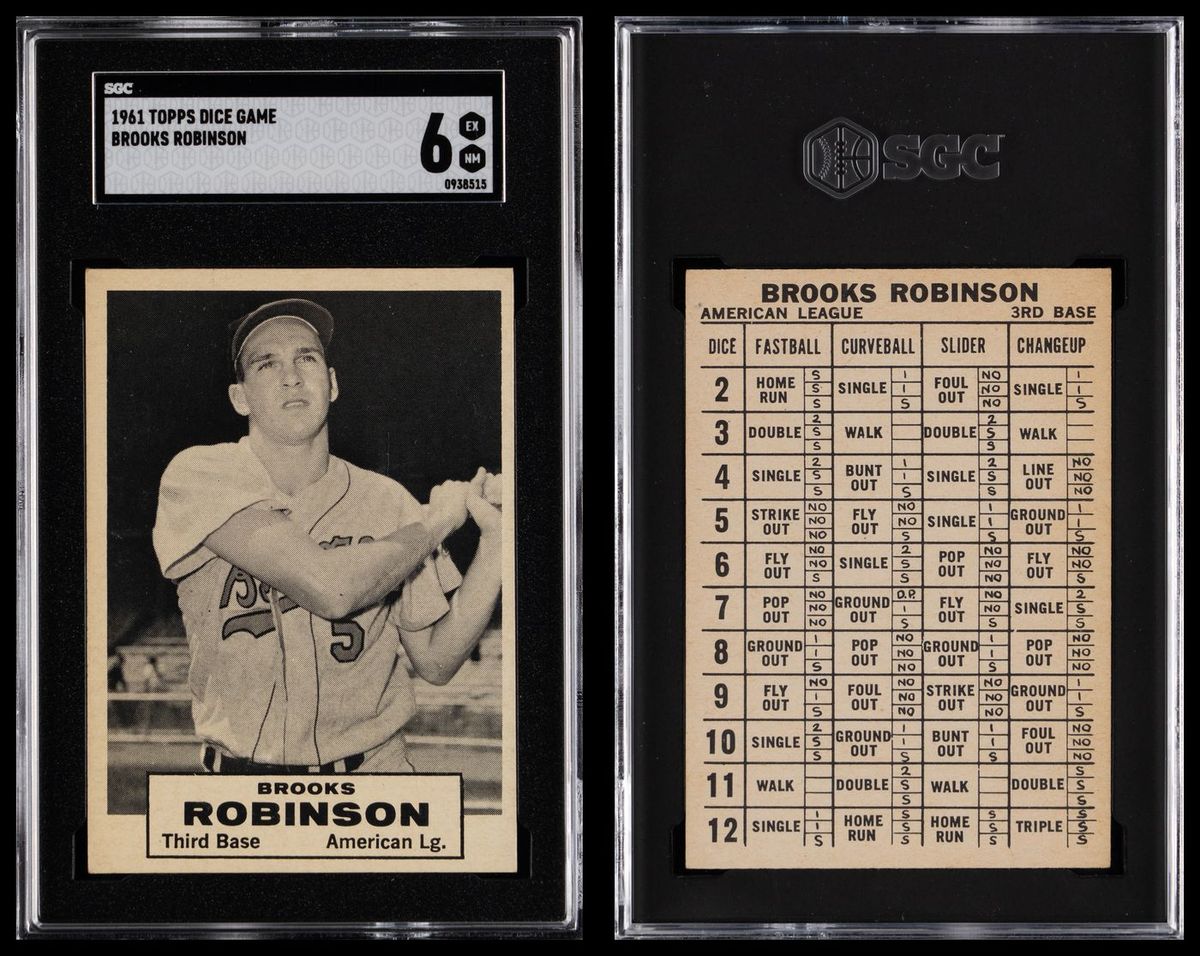
Look at the label on the holder, though. SGC calls it a 1961 Topps Dice Game, and SGC is right — but that is an attribution the hobby worked out on its own and printed on a slab in our lifetime. The company that made the card never put it in writing.
What they did write down, in great detail, is the game. Somebody sat in an office in Brooklyn in 1961 and worked out what ought to happen on every roll against every kind of pitch — roll a two against a fastball and Brooks Robinson homers; roll a twelve against a changeup and he legs out a triple. Twelve rows, four columns, all of it set in type. Whoever did that got paid for the week, and then the whole idea evaporated so completely that the only proof it happened is eighteen kinds of cardboard.
The card is Brooks Robinson, in a batting pose, watching a ball he has just hit — which is a slightly funny thing to catch the best glove in the history of third base doing. It is the finest Dice Game card of any player SGC has ever graded, by a full tier. Between SGC and PSA there are six Brooks Robinsons known, in any condition at all. It opened at $10,000 and closed at $72,000 on the night of September 10, the most anyone has paid for one.
And the one that turned up in a loaf of bread
The second-best result of the same night was also a Baltimore card, and it is the better story.
In 1921 a local bakery called White's put cards of the Orioles into loaves of Tip Top bread. Not the Orioles you are thinking of — this was the International League club, a minor league team so good it won seven straight pennants between 1919 and 1925, back when a minor league owner could simply decline to sell you his best player. The owner and manager was Jack Dunn, who has his own card in the set, and who a few years earlier had signed a Baltimore teenager named George Herman Ruth to his first professional contract.
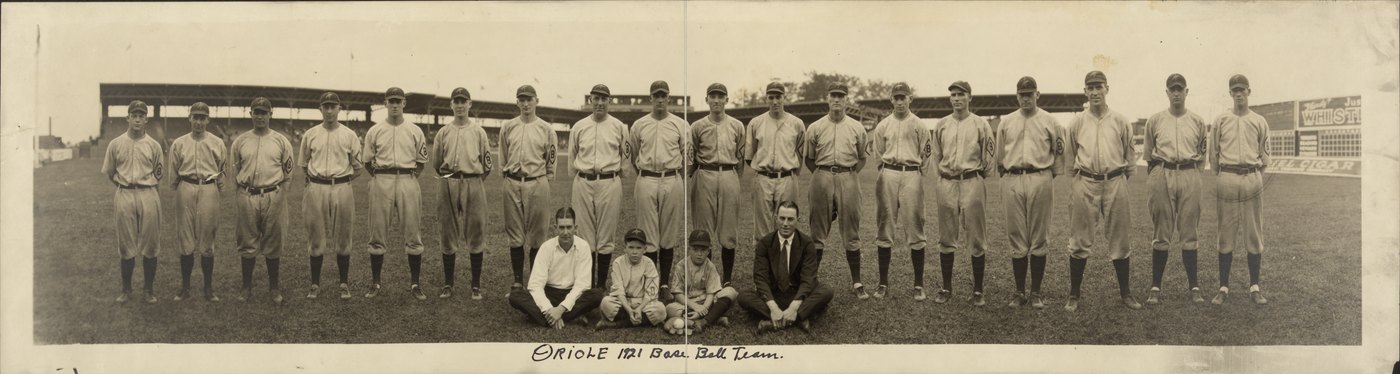
One of the twenty-two cards is the earliest picture of Lefty Grove on any piece of cardboard, made four years before he ever threw a pitch in the American League. He was a coal miner's son out of Lonaconing, Maryland, and he went 25 and 10 that summer. The card spells his name Groves, with an s, which is how a lot of people spelled it then, including whoever was writing the captions at the bakery.
Think about what that card was. Not a collectible, not an investment, not anything anybody was meant to keep. A slip of cardboard a Baltimore mom found in the bread and handed to her kid, or threw out.
The one that sold had not been in anybody's checklist. It came out of a new find that also turned up three cards from the set that nobody knew existed. It is graded Fair 1.5 — a hundred and five years of being a thing that came free with bread — and it brought $58,800. The third record of the night, a 1969 Jim McAndrew that happens to be the only one of its kind, went for $39,600.
One photograph, three cards
Which brings us to the photographs, because they are the same problem in better clothes.
On the fifth of March, 1951, a photographer for the International News Service spent a morning at Yankees spring training taking pictures of a nineteen-year-old from Commerce, Oklahoma, six weeks before Mickey Mantle played a major league game. One of those prints sold privately last week for $3,000,000 — brokered by Hunt Auctions, and reported by Sports Collectors Daily as the most anyone has ever paid for a sports photograph. Topps used that image on card number 311 the following year.
But the record it broke is the better story. In April 2024, Heritage sold a different Mantle print for $843,750. It had spent decades in a former teammate's collection; four copies of it are known to exist. And that one photograph is behind three separate cards, made three separate ways, by three companies who were not speaking to each other.
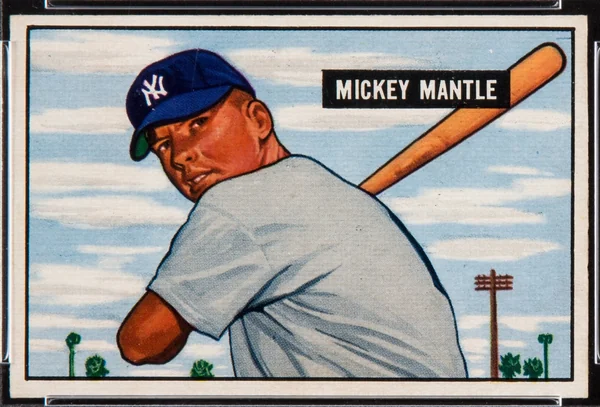
Bowman put it in front of an artist, who painted the picture you see above, and printed it as card number 253 in 1951 — which is Mantle's real rookie card, whatever the 1952 Topps has come to mean to people since. A year later a little outfit called Berk Ross tinted the photograph itself and put it in a set almost nobody collects; collectors have never been able to tell their Mantle apart from Bowman's. And in 1953 Topps paid an artist named Gerry Dvorak twenty-five dollars a card to paint the same man again.
So: one morning in Arizona, one roll of film, and a face that ended up painted twice, tinted once, and printed into millions of hands — while the actual piece of paper it all came from sat in a box for seventy years and nobody could have told you where.
There is a pattern in all three of these, and it has nothing to do with grades. A set with no copyright line. A card that was not on the checklist. A photograph everybody had seen and nobody could find. In every case the object came first and the record of it came long afterward — assembled backwards, years late, by people squinting at population reports and old bakery captions and the corner of a print.
Which is most of what this hobby actually is, once you get past the prices. Somebody kept a thing, usually without meaning to. Somebody else, much later, sat down and worked out what it was.
That's the good stuff. Not the numbers — the numbers are just how a story gets told loudly enough for the rest of us to hear it. It's knowing there is always another one out there, in a box, in an attic, mislabeled or not labeled at all, waiting for somebody to notice. That is what keeps us coming back week after week.
See you next Friday.
— Greg