He came into 1958 as the reigning Most Valuable Player on the World Series champions, and the Braves went back to the Series that fall. This time the Yankees came back from three games to one and won it. Aaron hit .326 with 30 home runs, and that season he won the first of his three Gold Gloves in right field, the part of his game people tend to forget.
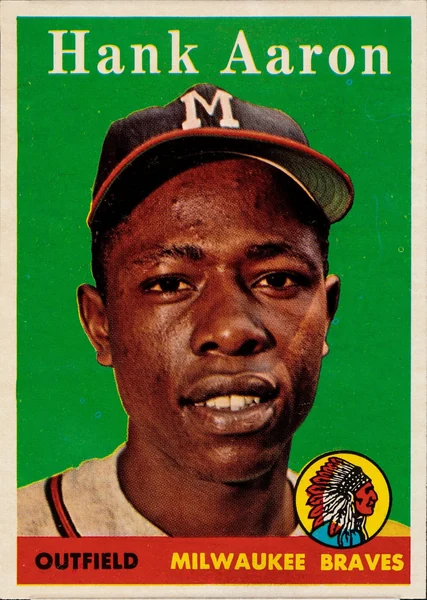
Topps changed the look again for 1958. Gone were the dark ballparks of the year before: each player was cut out of his photograph and set against a single flat color, with his name printed large across the top. Aaron’s ground is a clean green. Below him a red bar carries his position and team, and the Braves’ Indian head sits in a circle in the lower right corner. The set runs to 494 cards, at the standard size Topps had settled on the year before.
The name is the whole variation, and the yellow is the scarce one.
Card 30 is one of the cards that exist twice. Early in the set, among the numbers from 2 to 108, thirty-three cards were printed with the player’s name in white and also with it in yellow. Why is not entirely settled; the explanation usually given is a change of ink partway through the run. The white name is the ordinary card, the one on this page. The yellow was printed in far smaller numbers and is one of the better-known rarities of the decade. Otherwise the two are the same card.
It would be easy to pass over the white-letter Aaron for that reason, and a mistake. The picture is one of the best of him from the fifties: a tight portrait, the M on the cap, the eyes steady and a little guarded, a twenty-four-year-old who already had a batting title, an MVP and a ring. The flat green behind him does what the design intended. Nothing distracts from the face.
Flat color is unforgiving, though. A single print speck on a green field is visible across a room, and the 1958s have more than their share of them. The red bar along the bottom chips at the edges. Corners on the set are often soft, and the centering varies. A clean, well-centered white-letter Aaron is harder to find than its standing as the common version suggests.