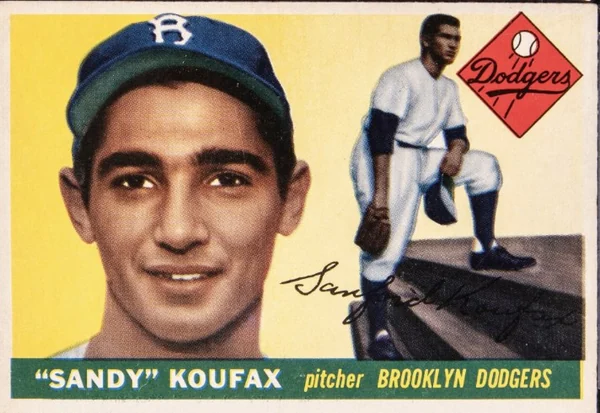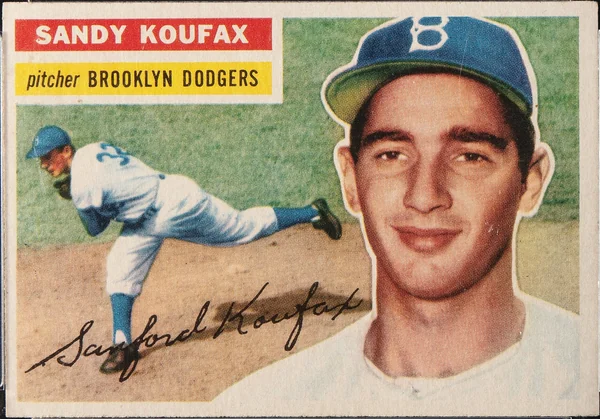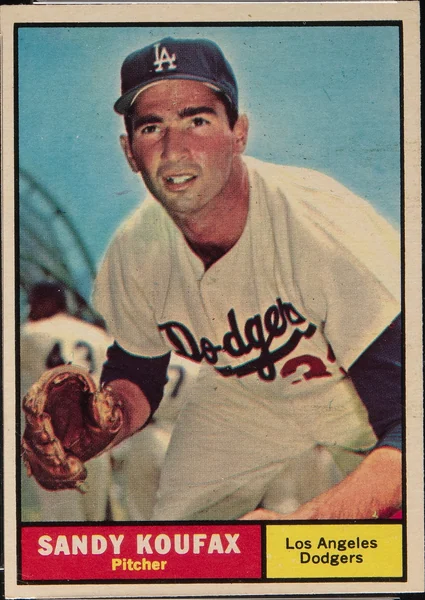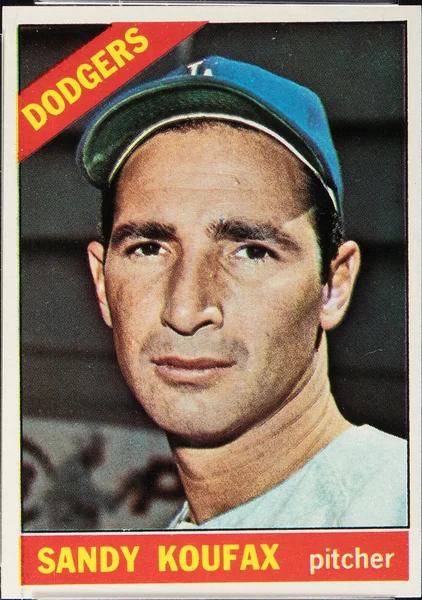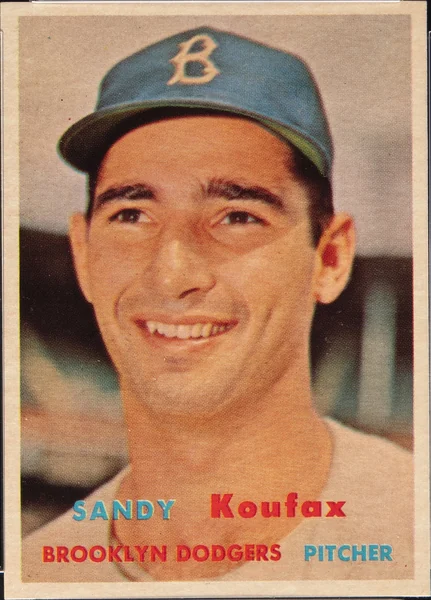
In 1957 Topps made two changes that have lasted. It used real color photographs on every front, with no paintings and no colorized black-and-white pictures, and it cut the card to 2 1/2 by 3 1/2 inches, the size Topps has used ever since. The set has 407 numbered cards.
Koufax's is a close head shot of a young man with a big, bright smile. On the back, printed in red and blue on gray cardboard, are his full career statistics, which in 1957 did not take much room: four wins in two seasons.
His career statistics on the back did not take much room: four wins in two seasons.
Number 302 falls in the fourth series, cards 265 through 352, which turned out to be the scarcest stretch of the set, comparable to the high numbers of other years and roughly twice as hard to find as its neighbors. The catalogs list #302 as one of the double prints within that series, though recent study of the press sheets suggests those cards were not in fact printed in greater numbers. Either way it is a middle number rather than a high one, and it is the key card of its series.
The season it was sold was his best so far, which is a modest thing to say: five wins, four losses, a 3.88 earned run average and 122 strikeouts in 104 innings. On September 29 he pitched an inning of relief in the last game the Brooklyn Dodgers ever played. The next season the club was in Los Angeles, which makes this his last mainstream card as a Brooklyn Dodger.
It is sometimes listed as a rookie card. It is not; that is the 1955 Topps. Centering and soft corners keep most copies from the top grades, and excess ink on the front is a common flaw in this series.