The $12.26 Million Jersey
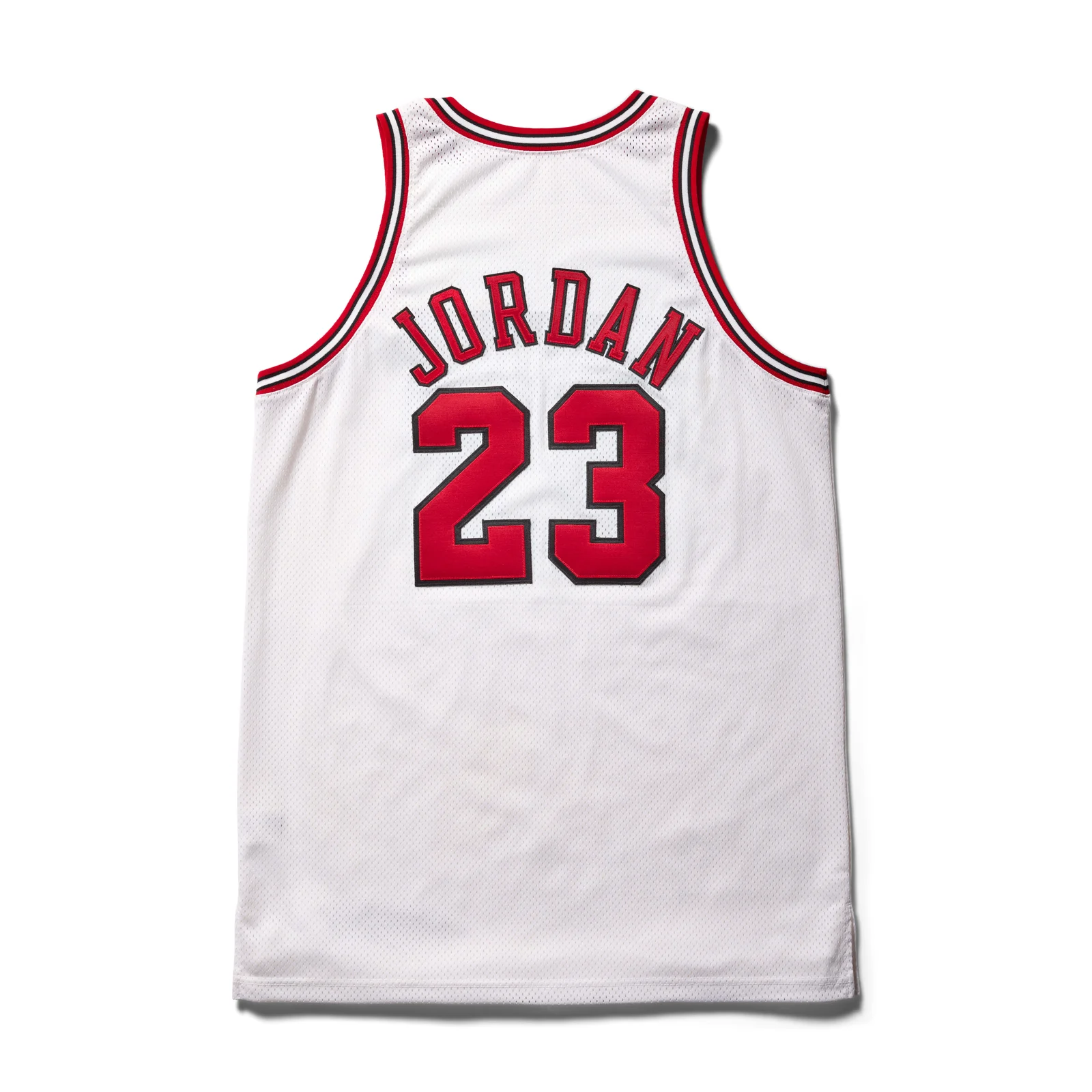
On the evening of Tuesday, September 29, Joopiter — Pharrell Williams's auction house — sold the jersey Michael Jordan wore in Game 3 of the 1998 NBA Finals for $12.26 million. That's the most ever paid for a Jordan jersey. It beats, by about $2.2 million, the $10.091 million that his Game 1 jersey from the same series brought at Sotheby's in 2022. Only Babe Ruth's 1932 World Series jersey, at $24.12 million in 2024, has ever sold for more as game-worn memorabilia.
The first thing I noticed was that there was one bid, according to The Athletic. Joopiter had guided it somewhere between $10 and $15 million, and one buyer decided that was about right. So there was no bidding war to read, no second person who wanted it just as badly. That's a very different kind of price from the Flagg card in the next section, which took eighty-three bids, or the Koufax after that, where two people have to want the same copy on the same afternoon.
The game itself is part of the appeal. The Bulls beat the Jazz 96–54 that night, Jordan scored 24, and Chicago went up 2–1 on the way to a sixth title. It's the only white jersey from that Finals that has ever surfaced publicly. MeiGray authenticated it in 2015, and it's been photo-matched to two Getty Images photographs from the game. Its seller, Rob Gough, bought it in 2023. The NBA wasn't tracking game-worn jerseys then, and teams washed and reused them, which is why so few survive.
For scale: last week we wrote about a PSA 10 Fleer Jordan rookie that brought $402,600. The jersey is about thirty times that. And a 1985 Star Company "Last 11 R.O.Y." Jordan in PSA 8 brought $18,450 at REA on September 20, which makes the climb from that card to this jersey roughly 660-fold for the same man. A card is one of many; there are 335 perfect-10 Jordan rookies out there. A jersey is one of one. The jersey's price measures how much one person wanted the only one there is. A card's price has to be earned in a room full of rivals.
The $8.04 Million Patch
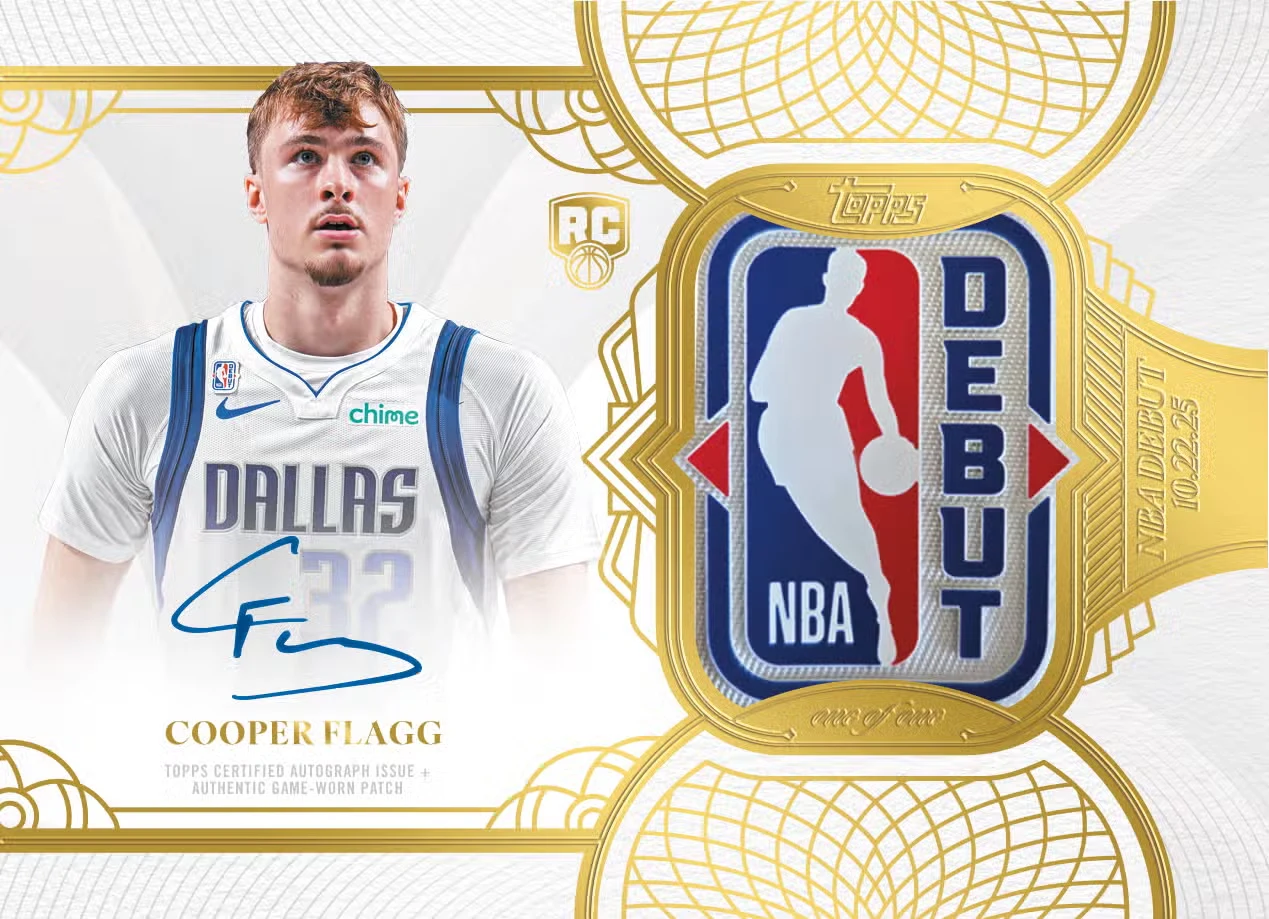
Four days before the jersey, another one-of-one changed hands. Early on Friday, September 25, Cooper Flagg's NBA Rookie Debut Patch Auto, a Topps card built from his first game as a pro, closed at $8.04 million in Fanatics Collect's September Premier Auction. That is the most ever paid for a basketball card of a single player, and the most ever paid for a debut patch, ahead of the $1.1 million that Paul Skenes's brought. Only two NBA cards have sold for more, and both are Michael Jordan cards paired with another star. Before this, the most any Flagg card had brought was $366,000.
Every rookie in the 2025 class wore a patch on his jersey in his first NBA game. When the game ended it was cut away, set into a card and signed. Flagg's first game came on October 22, 2025. The Mavericks lost 125–92 to the Spurs, and he finished with ten points and ten rebounds. The patch that was on his chest that night is the card. There is exactly one.
Set the two prices side by side. The jersey drew one bid. The Flagg card drew eighty-three over two weeks of bidding, from September 10 to 24, and most of the drama came at the very end: around 9 p.m. ET on Thursday, September 24, it stood at $3.5 million, and by 2 a.m. Friday, September 25, it had reached $8.04 million. That's $4.5 million in five hours. The same auction sold Dylan Harper's debut patch for $2.88 million and Kon Knueppel's for $2.34 million.
The timing lines up with the calendar. NBA preseason tipped off on October 3, the Mavericks play the Rockets in Macao on October 9 and 11, and the regular season opens on October 20. Flagg's second season is about to begin, and the card from his first game is already in the record books.
Same Mickey, Same Money
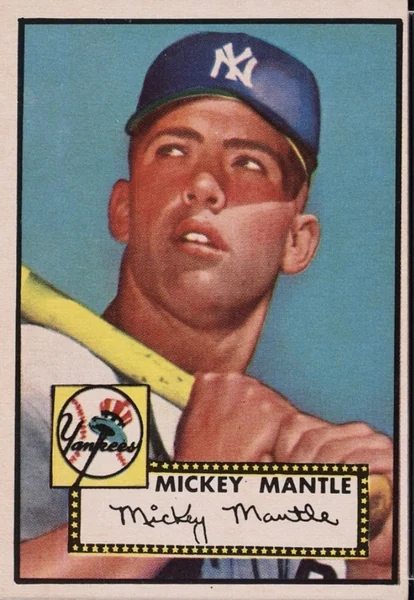
REA's September auction closed on the night of September 20, more than 4,600 lots deep. Two of its Mantle results landed on exactly the same number: $76,875.
One was a 1956 Topps Mickey Mantle, the Gray Back, graded PSA 8.5, a record for the card in that grade by more than $20,000. The other was a 1952 Topps Mantle, the famous one, graded PSA 1.5, one notch above the bottom of PSA's scale. Seven grade points apart, and the same price.
The 1952 is the one worth staring at, because we've watched it sell all summer. Here is what that same card has brought, grade by grade:
| PSA grade | Price | Where |
|---|---|---|
| 1.5 | $76,875 | REA, September 20 |
| 3.5 | $390,400 | Heritage, August (MBA Silver) |
| 7 | $716,750 | Heritage, August |
| 8 | $3,721,000 | Heritage, August (MBA Silver) |
Look at the shape of it. From a 1.5 to a 3.5 is two grade points, and the price multiplies by five. From a 7 to an 8 is one grade point, and it multiplies by five again, from $716,750 to $3,721,000. The PSA 3.5 and the PSA 8 both carried an MBA Silver designation in Heritage's catalog, a second-opinion sticker that buyers weigh alongside the PSA grade, so part of those steps is the label as well as the number.
Two October Men
The Division Series began on Saturday, October 3, the League Championship Series open October 11, and the World Series starts October 23. Here are two men who owned October, and the cards of theirs that just set records at Memory Lane's Summer Rarities auction.
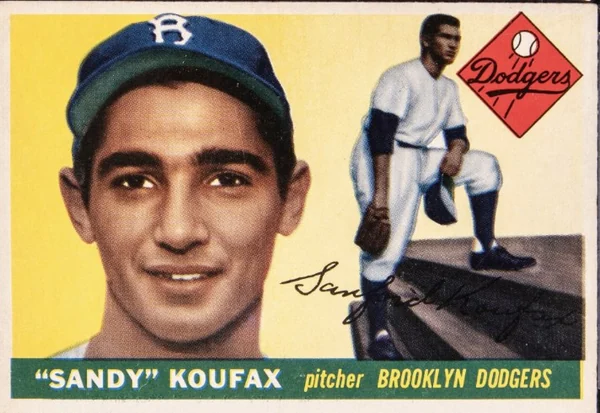
Sandy Koufax, 1965. Koufax sat out Game 1 of that World Series because it fell on Yom Kippur, and the Dodgers lost. They were down two games to none when he came back. He threw a four-hit shutout in Game 5 with ten strikeouts, then pitched Game 7 on two days' rest and shut Minnesota out again, on three hits. That's the man on the 1955 Topps rookie that sold for $604,736 at PSA 9, a record for the card, over the old mark of $396,000 from 2022. Memory Lane's catalog describes that copy as carrying a gold MBA designation. Another PSA 9 sold in July for $390,000, without an MBA designation. The Heirloom Index follows this card as well, at the PSA 6 grade.
Roberto Clemente, 1971. Down two games to none himself, Clemente hit .414 against Baltimore, reached base in all seven games, hit a home run in the deciding Game 7, and was named Series MVP — at thirty-seven, in the last World Series of his career. His 1971 Topps card, No. 630, graded PSA 9, just brought $170,579, a record for the card. The reason a nine is so hard to find has to do with the printing: Topps used black borders that year, and black borders show every chip and scuff. Somebody kept that card clean for fifty-five years.
One more, for the Braves fans. Hank Aaron's 1954 Topps rookie brought $20,295 at REA in PSA 6, a record for the grade. It's one of the 25 cards at the center of The Heirloom Index.
Coming Up
REA's October auction runs October 8 through 18, so it's open as you read this. If you'd like to follow any of this week's cards across every auction house at once, the Radar at The Heirloom Index does exactly that, and you can add any card you like.
Every object in this issue began as part of a single night. Jordan's jersey was on his back for a game the Bulls won by 42. Flagg's patch came off his jersey after ten points and ten rebounds in a loss, the first night of a career that is barely a year old. Koufax took the mound on two days' rest and finished the job. Clemente, at thirty-seven, hit a home run in a Game 7, and a card with his name on it was kept clean for fifty-five years. Prices are what we report; they're public, and they're interesting. The nights are the reason we're paying attention. Somebody was in the seats for every one of them, and somebody still remembers.
— Greg