Weekend Reading is a short Friday column on the stories behind the cards people collect and what they bring at auction. On Friday, October 23, the Milwaukee Brewers play Game 1 of the World Series at home against the Tampa Bay Rays, so this week I went back to the only time a Milwaukee team won one.
Hank Aaron Hit .393
Milwaukee has been here three times before. The Braves made it in 1957 and again in 1958, both times against the Yankees, and the Brewers made it in 1982 and lost to the Cardinals in seven. Only one of those ended with a trophy.
In 1957 the Braves were in their fifth season in Milwaukee, and their best hitter was 23 years old. Henry Aaron had already clinched the pennant for them on September 23, with an 11th-inning home run at County Stadium, and he’d soon be named the National League’s MVP. Against the Yankees he hit .393: 11 hits in 28 at-bats, three home runs, seven runs batted in. My favorite story from that Series is Game 4. Casey Stengel reportedly decided to pitch to Aaron, figuring not even Babe Ruth could hit one out in that wind. Aaron hit a three-run homer. Afterward Stengel’s answer, more or less, was that the kid wasn’t Babe Ruth.
The other hero was a pitcher. Lew Burdette won three games, two of them shutouts, the last a 5–0 finish at Yankee Stadium on October 10, and he was named Series MVP. The Braves packed up for Atlanta after the 1965 season, but Aaron found his way back. He finished his career with the Brewers and hit his 755th and last home run in Milwaukee, at County Stadium, on July 20, 1976. He was 23 in that 1957 World Series, and he played 23 seasons in the majors. Some numbers just line up.
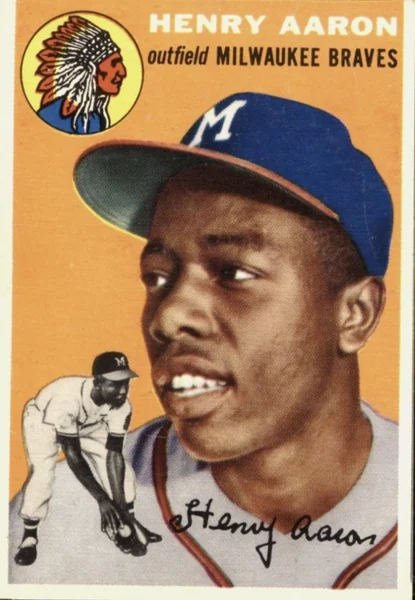
His rookie card is the 1954 Topps, No. 128, one of the thirty-nine cards we follow, and I’ve always loved how Milwaukee it is. It calls him Henry, not Hank. It says Milwaukee Braves right across the top and puts an M on his cap, three years before the title. A PSA 8 brought $66,496 at Memory Lane on September 26, 2026, buyer’s premium included.
Graded Authentic, Signed a 9
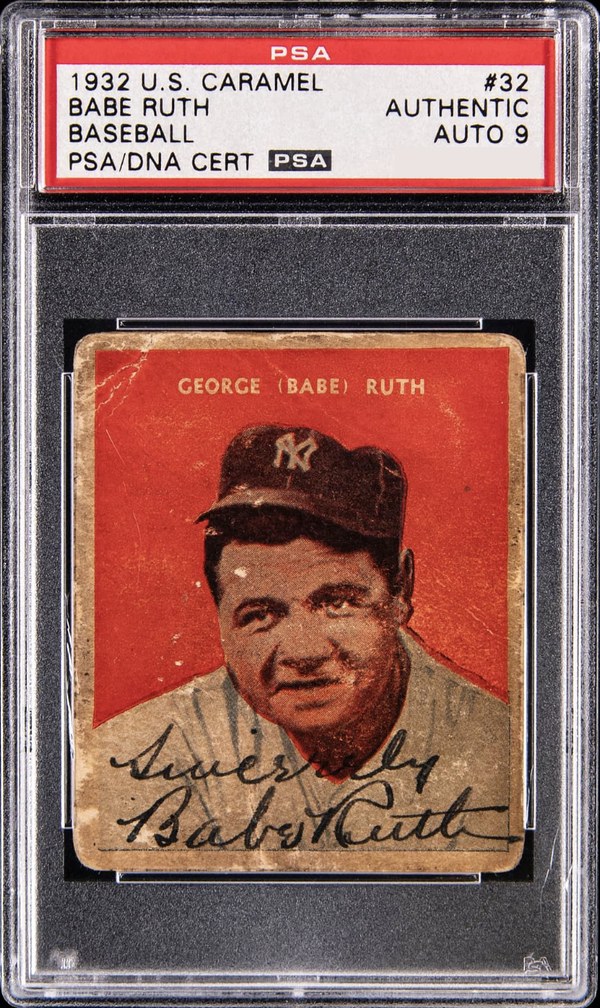
Since Stengel brought him up, let’s talk about the Babe. Goldin’s Fall Vintage Elite auction closed in the early hours of October 11, after extended bidding, and the top lot was a 1932 U.S. Caramel Babe Ruth, No. 32, signed in black fountain pen. It sold for $976,000.
Look at the label on the holder, because it tells the whole story. PSA graded the card Authentic, which means no number at all, and gave the signature a 9. In other words, nobody was paying for the corners. U.S. Caramel made 32 cards in 1932, mixing baseball players with stars from other sports, and this is the only signed copy known from the whole set. There isn’t a second one to compare it to.
Two other results from that night stuck with me. A Charles Conlon photograph of Ty Cobb sliding into third at Hilltop Park in 1910, one of the great early action pictures in baseball, brought $945,500. And an empty 1952 Topps one-cent display box, a cardboard box with nothing in it, brought $86,213, which Sports Collectors Daily called almost certainly a record for a display box. Plenty of those boxes went out with the trash in 1952.
A Record That Lasted Two Weeks
On October 9 this column led with a Michael Jordan jersey: the one he wore in Game 3 of the 1998 Finals, sold by Joopiter on September 29 for $12.26 million, the most ever paid for a Jordan jersey. It held that title for about two weeks. On October 12, Hunt Auctions announced that the red road jersey he wore in Game 2 of the same series, signed, had sold for $14 million. That was June 5, 1998: Jordan scored 37, and the Bulls won 93–88 to even the series. Hunt calls it the most ever paid for a piece of basketball memorabilia.
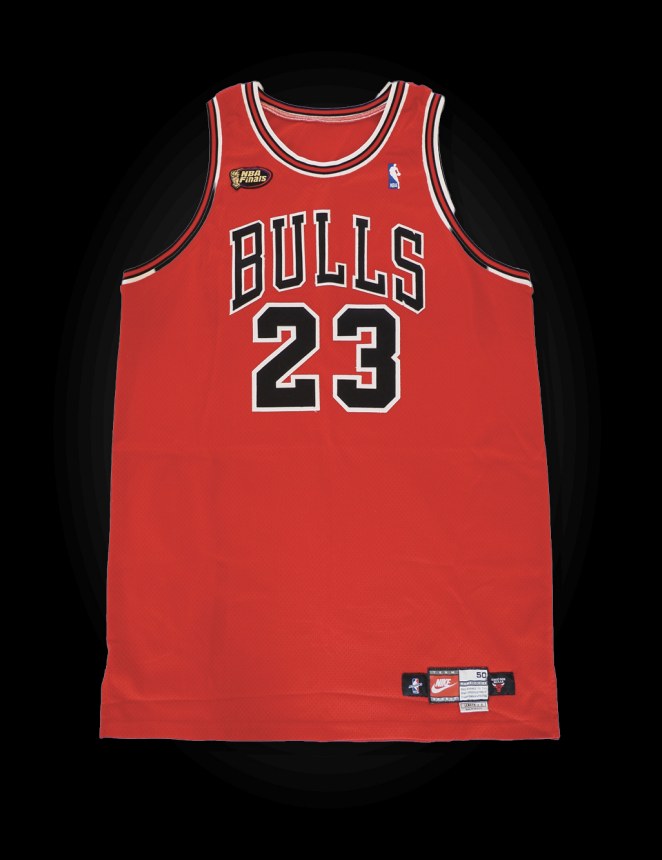
This one never went to auction. Hunt brokered it as a private sale: one seller, one buyer, and a price the two of them agreed on. No bidding at all. The Game 3 jersey two weeks earlier sold on a single bid, so the two biggest Jordan jersey sales ever came with one bid between them. Both are real money. But a price settled in private tells you what one buyer was willing to pay. A card that sells with a room full of bidders watching tells you what the market will bear.
Three jerseys from that one series have now sold: Game 1 for about $10.1 million in 2022, Game 3 for $12.26 million and Game 2 for $14 million. Only one piece of game-worn clothing has ever brought more, and fittingly it’s a World Series story too: Babe Ruth’s jersey from 1932, $24.12 million in 2024.
On the Block
Heritage, closes October 23–25. For World Series week, a ticket to Game 1 of the first one, Pittsburgh at Boston on October 1, 1903, at the Huntington Avenue Grounds. It’s about an inch and a half by three and a half inches, creased, printed “Boston vs. Pittsburg” without the h, and there’s a handwritten note to someone named Charlie on the back. I love this one. Heritage says it is one of two known, and it came from Barry Halper’s collection.
Rabbit Hole Auctions, closes November 1. A smaller house, about 170 lots in its second sale. Among them a 1954 Topps Hank Aaron, the same card as above, and a 1956 Topps vending machine display showing six Hall of Famers, among them Willie Mays, Sandy Koufax and Ted Williams.
From around the hobby
Henry Aaron in the World Series (SABR). Both of his Octobers, 1957 and 1958, game by game, if the section above left you wanting more.
The Artwork That Became Sid Gordon’s 1953 Topps Card (PostWarCards). The original painting beside the finished card, from the Braves’ first year in Milwaukee.
Henry Aaron’s Earliest and Rarest Card (SABR Baseball Cards blog). The case for a 1952 postcard of Aaron at 18, with the Indianapolis Clowns, before the Braves ever signed him.
Three prices this week, set three different ways. The Aaron sold in a room where every bidder could look up what the last one brought. The Ruth went to whoever wanted the only one there is, after the bidding ran past midnight. The Jordan never went to auction at all. When you see a big number, it’s worth asking which kind it is. As for Milwaukee, its only World Series title belongs to the Braves, and the Braves left for Atlanta after 1965. The Brewers have never won one. They got there once, in 1982, and lost in seven. So for sixty-nine years, the answer to “when did Milwaukee last win the World Series?” has been a 23-year-old with an M on his cap, playing for a team that isn’t there anymore. Starting October 23, the Brewers get their chance to give the city a new answer.
— Greg