Weekend Reading is a short Friday column on the stories behind the cards people collect and what they bring at auction. Fifty years ago this month, the most famous player in the other league finally walked onto an NBA floor, and this week I wanted to start there.
Dr. J, October 22, 1976
For five seasons the best show in basketball was in the ABA. Julius Erving won three MVP awards there and two titles with the New York Nets, and a lot of fans had only heard about what he could do. When the leagues merged in the summer of 1976, the Nets came into the NBA owing the Knicks a $4.8 million fee for moving into their territory. To pay it, they sold Erving’s contract to the Philadelphia 76ers, for about $3 million.
He played his first NBA game on October 22, 1976, at the Spectrum, against another team that had just come over from the ABA, the San Antonio Spurs. The Sixers lost it, 121–118. I’ve always liked that. The most famous player in the building started his NBA life as the new guy on a team that lost its opener. By the spring he had them in the Finals, and he went on to the 1981 MVP and the 1983 championship.
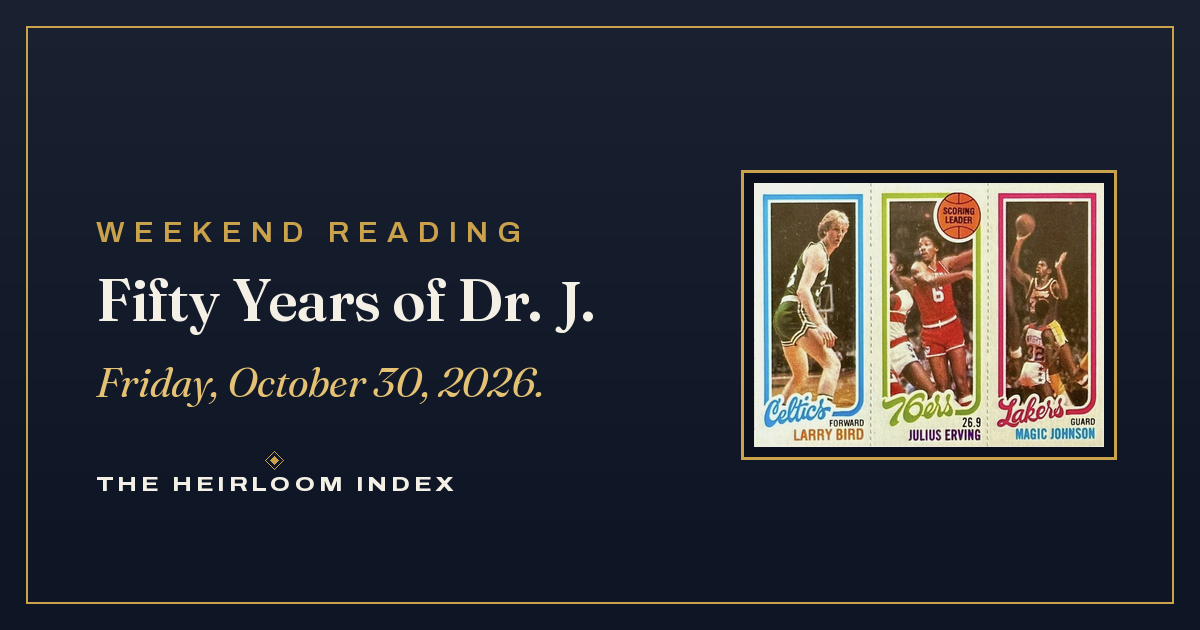
Topps couldn’t keep up with him. His 1976-77 Topps card is No. 1 in the set, and it still shows him as a Net, because it went to press before the sale. The card of his I’d point you to is the one he shares. The 1980-81 Topps panel with Larry Bird on the left and Magic Johnson on the right is the rookie card of both, and one of the thirty-nine cards we follow. The man in the middle is Erving, in 76ers red, with a small basketball-shaped badge that reads SCORING LEADER and 26.9, his average the season before.
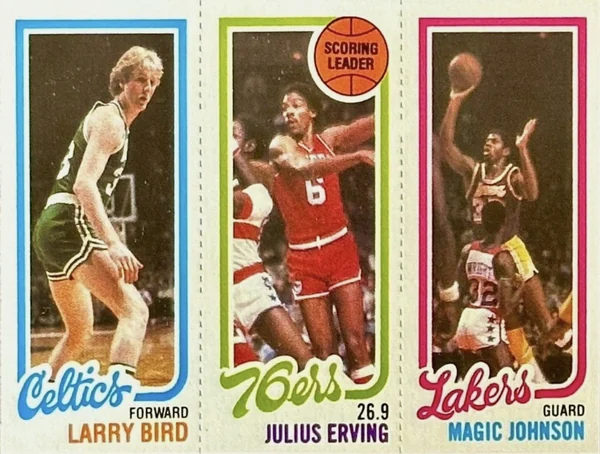
Two second-year players who would carry the league through the next decade, and Dr. J standing between them. Bird and Magic get the credit for this card, but when it came out, the man in the middle was the biggest star of the three. He won the MVP that very season.
A PSA 1 Brought $153,750
REA’s October auction closed on Sunday night, October 18. More than 6,000 lots, and the top one was a card graded PSA 1, the bottom of PSA’s number scale.
It’s a T206 Ty Cobb, the red-background portrait, and nobody was paying for the front. Turn it over and the back advertises Ty Cobb tobacco, a brand named for him, a back found only on that one Cobb card and on very few of those. Creases and all, it brought $153,750.
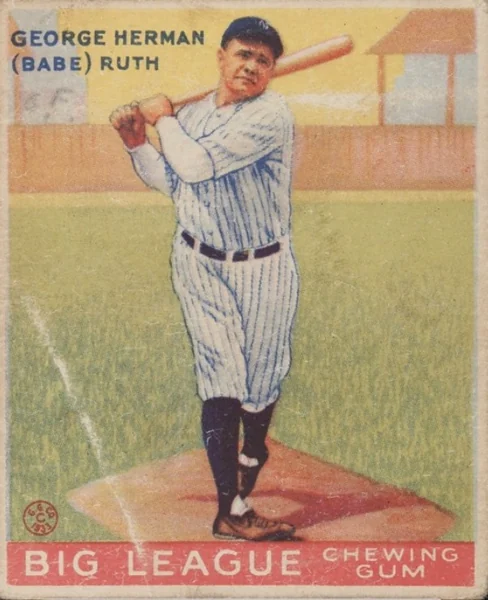
Two more from the same sale make the point. A 1933 Goudey Babe Ruth, No. 144, one of our thirty-nine, in PSA 1.5: $17,220. A 1954 Topps Ted Williams, card No. 1, in a lovely PSA 8.5: $41,820. So a PSA 1 outsold a high-grade Ted Williams more than three to one. This surprises people every time, and it’s worth keeping in your back pocket. The number on the label describes the condition of the cardboard. It says nothing about how many of the card exist, and scarcity usually sets the price before condition does.
About 250 Packages, One Truck
On October 13, someone broke into an unattended FedEx truck outside PSA’s headquarters in Santa Ana, California, and made off with two pallets of graded cards that were on their way back to the people who had sent them in. Police put the loss at $963,000 or more, and Sports Illustrated counted about 250 packages. Sports cards and Pokémon both. No specific cards have been named.
PSA says it has deactivated the certification number on every stolen card and will pay the owners fair market value. That second step is the useful part for the rest of us. Every PSA holder carries a certification number, and anyone can type it into PSA’s free cert lookup. A stolen card can be put back into circulation, but its number can’t be made clean again. Before you buy a graded card from anyone, look the number up and make sure the page matches the card in front of you: same player, same year, same grade. If it doesn’t, or PSA has pulled it, that’s your answer. It takes about thirty seconds.
On the Block
Love of the Game, closes October 31. A sale built entirely from Topps cards, for the 75th year of Topps baseball, with an unopened 1952 Topps pack graded PSA 7 among the lots. Seventy-four years, and nobody has opened it.
Goldin, runs through November 4. In the fall photography auction, the original photograph, taken by Henry Barr, used for Jim Brown’s 1958 Topps rookie card, another of our thirty-nine. If you love that card, here’s where its picture started.
SCP Auctions, fall sale from October 29. The one-of-one Topps NOW card made for Shohei Ohtani’s 300th home run.
From around the hobby
The Doctor Arrives (Sports Collectors Daily). More on Erving’s cards, from his 1972-73 rookie to the 1976-77 card that went to press with him still a Net.
Card Care vs. Card Alteration: Where Is the Line? (Sports Illustrated). A sensible read on where cleaning a card ends and changing it begins.
Vintage Set of the Week: 1972 Topps (Sports Collectors Daily). The loudest design Topps ever printed, and how a set that size came together.
Topps printed Julius Erving as a Net weeks after he’d become a 76er, and that card is still No. 1 in its set. Four years later Topps put him between two young players named Bird and Magic, and that card became the one everybody chases. A card can only show what the people who made it knew on the day it went to press. Sometimes they were a step behind. Every so often, without meaning to be, they were a step ahead.
— Greg
P.S. In the October 23 edition I wrote that for sixty-nine years the answer to “when did Milwaukee last win the World Series?” had been a 23-year-old named Henry Aaron. On October 28 the Brewers changed it. They beat the Rays 4–1 at Tropicana Field to take the Series in five games, the first championship in the franchise’s history, and William Contreras was named Series MVP. Congratulations, Milwaukee.