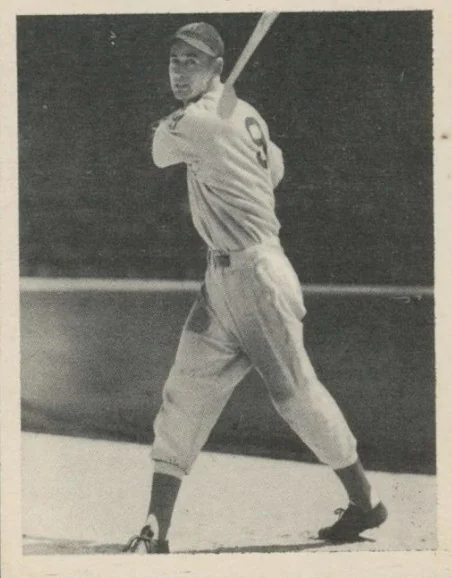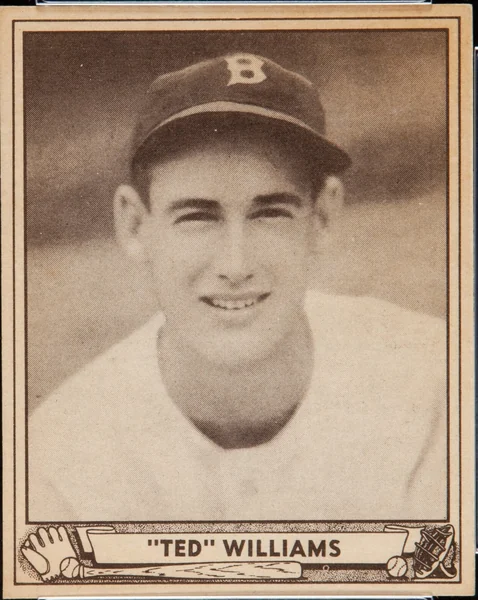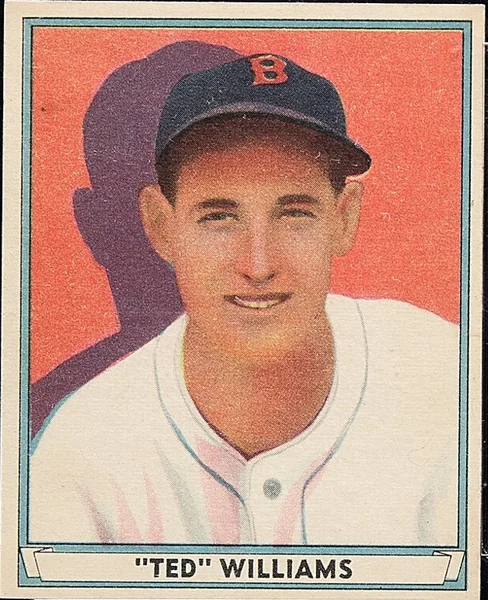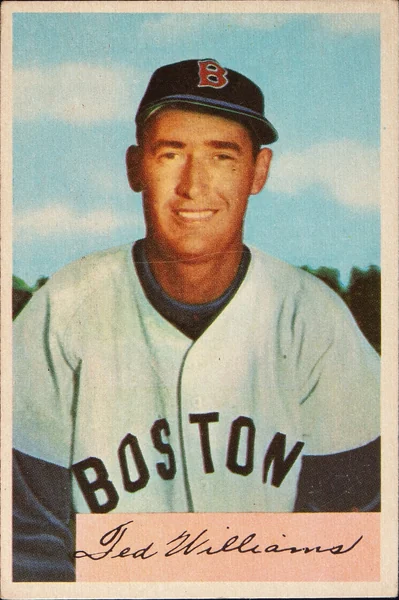
Ted Williams had been a Bowman player. In 1954 Topps signed him to a five-year contract, the first time the company paid a player more than its standard rate to appear on a card, and it made the most of him. He is the first card in the 1954 set and the last, number 1 and number 250.
Topps paid more than its standard rate to sign him, and put him first and last.
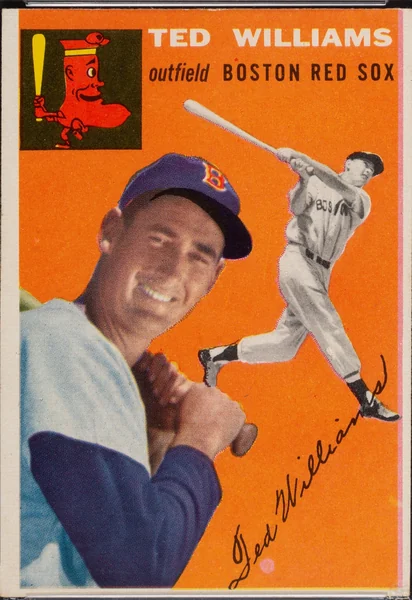
The set was the first Topps design to put two pictures on a front: a large color portrait and a smaller black-and-white figure in action, a big team logo at the top and a facsimile signature at the bottom, the color running to the top edge. On #1 he is shown twice, both times with a bat, on an orange ground. Number 250 uses different pictures, on a bright yellow ground.
He had come home from Korea in August 1953, after flying about thirty-nine combat missions, and hit .407 in 37 games. On March 1, 1954, the first day of spring training, he broke his left collarbone in Sarasota going after a sinking line drive. He came back and hit .345 with 29 home runs, fell fourteen at-bats short of qualifying for the batting title, led the league with 136 walks, and after the last game said he was retiring. He was back in the lineup by the end of the next May.
Number 1 tended to end up on top of a stack of cards and took the wear that came with it; number 250 settled at the bottom. #250 has long been thought the harder of the two, and its yellow shows every print flaw. Centering and chipped edges trouble both.
When Topps reprinted the 1954 set in 1994, it left out #1 and #250. By then Williams was under exclusive contract to Upper Deck.