Weekend Reading is a short Friday column on the stories behind the cards people collect and what they bring at auction. On October 20, in our Tuesday post on what was closing, we named three cards in Heritage’s fall sale. Two of them came back on Friday night, October 23, as records.
Babe Ruth, $112,850
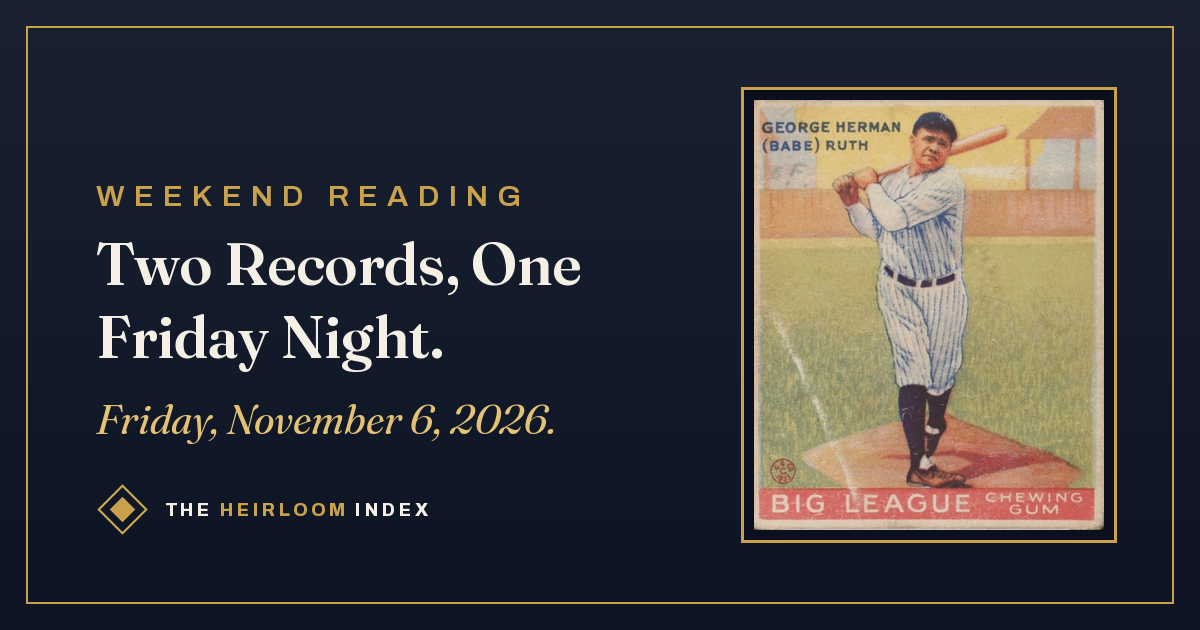
The 1933 Goudey Babe Ruth, No. 144, is one of the thirty-nine cards we follow, and it’s the Ruth I’d hand to anyone who asked what a Ruth card looks like. Goudey put him in the set four times, and this is the only one that shows him head to toe, in pinstripes, the bat all the way through its swing.
A copy graded PSA 6 sold at Heritage on October 23 for $112,850. Sports Illustrated called it the highest price yet for that card in that grade. The last PSA 6 to sell publicly went for $96,000, on June 19 of this year.
One thing worth knowing when you see the word “record” in a headline: it nearly always means a record for that card at that grade. A PSA 8 of the same Ruth sold at Heritage in January 2025 for $183,000. Both numbers are true. They’re different rungs of the same ladder. And a small aside I love: No. 144 is the easiest of the four Goudey Ruths to find, because Goudey printed it twice on the same sheet, in the space card No. 106 would have taken.
Sandy Koufax, $170,800
Same night, same sale: Sandy Koufax’s rookie card, the 1955 Topps No. 123, graded PSA 8.5, brought $170,800. The last PSA 8.5 to sell publicly went for $102,000, in December 2022.
Turn the card over and there’s no minor-league record on the back, because there wasn’t one. Koufax signed with Brooklyn in December 1954 for a bonus big enough that the rules kept him on the major-league roster from the start. He was nineteen, threw hard and walked a lot of people, and for years he was a pitcher the Dodgers were waiting on. Then, from 1962 through 1966, he went 111–34 and led the league in earned run average every season. The card is the kid before any of that, smiling in a Brooklyn cap.
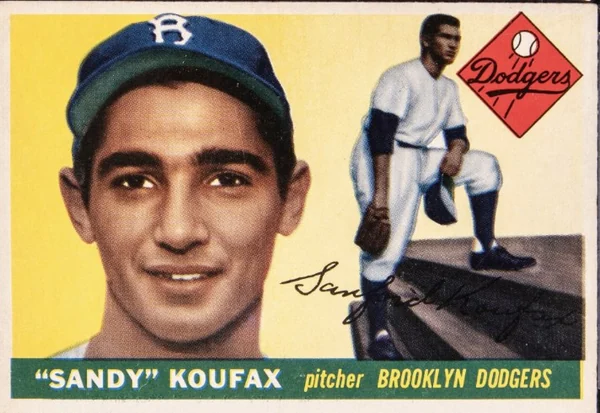
If you ever hold one, look at the yellow. It shows every print spot and stray line, which is why a clean one stands out across a room.
Honus Wagner, $1,982,500, Again
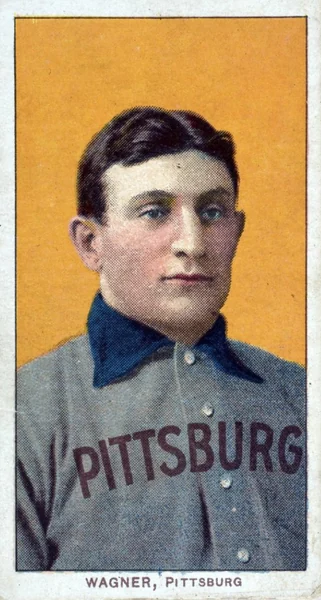
The biggest price of the weekend went to a T206 Honus Wagner, and not a pretty one. PSA graded it Authentic and noted that color had been added and the borders trimmed. In other words, PSA confirms it’s a real Wagner but won’t give it a number. It sold for $1,982,500.
Sports Collectors Daily pointed out that the same card sold for $1,968,000 in September 2023 and for about $1.98 million in April 2025. Three sales in a little over three years, and the price has moved by less than one percent. I find that one worth remembering. A restored card is still the card, and for the most famous card there is, people will pay seven figures just to own a real one.
The same sale set new highs for two Mantles, a 1960 Topps in PSA 9 at $329,400 and a 1963 Topps in PSA 9 at $317,200, and for a 1952 Topps Willie Mays, No. 261, in PSA 8 at $292,800. All told, Sports Collectors Daily put the sale at more than $25.6 million.
On the Block
Heritage, closes November 21. In the November Sports Showcase, a 1986 Fleer Michael Jordan, No. 57, in PSA 9, the card most people mean when they say “Jordan rookie,” and another of the thirty-nine cards we follow.
SCP Auctions, through November 15. A 1965 Topps Joe Namath, No. 122, in PSA 6, the tall card from his first year with the Jets.
Morphy’s, November 10 to 12. A 1933 Goudey Babe Ruth graded SGC 60. This one isn’t No. 144: it’s No. 53, the half-length Ruth on yellow.
From around the hobby
Before They Were Famous for Something Else (Sports Collectors Daily). Eight vintage players whose cards caught them before a second career, from Moe Berg to Bob Uecker.
Topps Busted Out Plastic Players (Sports Collectors Daily). The 1968 All Star Plaks, small plastic busts sold in dime packs, and why so few turn up.
Two cards set records on October 23 because two buyers wanted those copies more than anyone had before. The Wagner did something quieter. The same piece of cardboard has gone through three auctions in three years and come out at almost the same price each time. A record tells you what one buyer paid on one night. It doesn’t tell you what the card usually sells for. For that, look at the last few sales of the same card at the same grade. When they agree, the way the Wagner’s three sales do, that’s a far better guide than any single record.
— Greg