On July 13, 1951, a nineteen-year-old Yankees outfielder struck out three times against Cleveland and was told afterward that he was going to Kansas City. He had reported to camp that spring wearing number 6, not a number the Yankees handed out lightly, and had spent June demonstrating that he could not yet hit a major-league curveball. In Kansas City he went on failing. He telephoned his father in Oklahoma and said he thought he was finished, and Mutt Mantle drove up and began putting his son’s clothes back into the suitcase. The boy hit .361 over 40 games for the Blues and was recalled on August 20. He came back wearing 7.
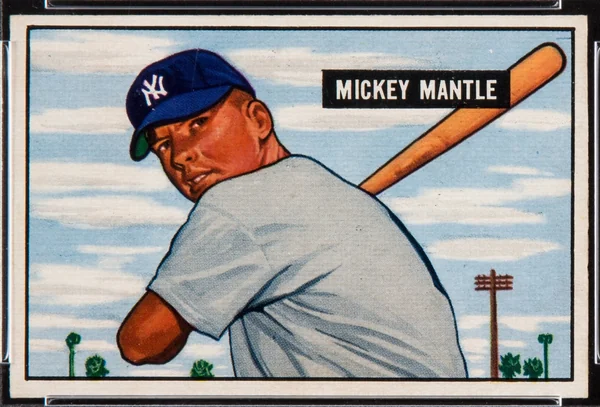
The card was made that same summer, and it is the only rookie card he has. Bowman’s 1951 issue runs to 324 cards, the largest set the company ever printed, each one 2 1/16 by 3 1/8 inches. That is more than half an inch longer than the squarish 1950 card, and the added height was not vanity: it made room for a thin black plate carrying the player’s name, position and team. Bowman had left the 1950 fronts bare — picture and nothing else, no name anywhere on the face of the card. In 1951 the names came back and stayed.
Bowman had left the 1950 fronts bare. In 1951 the names came back and stayed.
Number 253 puts him in the high numbers at the back of the set — the group that went to press late in the season and in much smaller quantities than what came before, which is why an ordinary player from that run is harder to turn up than a star from the front of the book. Willie Mays is back there too, at 305. Two of the postwar era’s consequential first cards came off the same late sheet, by an accident of scheduling — and they have a second thing in common. Of the 324 cards in the set, 39 were printed sideways rather than upright, and the Mantle and the Mays are both among them. So the rookie card of each is the rare shape: a horizontal picture in a set that is otherwise a column of portraits.
The fronts are color artwork worked up from photographs, as nearly every card of the period was; the painter’s job was to resemble the photograph and stay out of the way. Turned on its side, this one has room for the swing: the bat up and across the top corner, the ballpark light standard small behind him, the name plate set into the sky. Nothing on the front knows that the club had already sent him down once, or what it had taken to keep him from going home to Oklahoma for good.
What goes wrong with it is the high number’s usual catalog, arriving all together. Print lines run through the artwork on cards from the last series more often than on the early ones. The reverses picked up wax staining from the packs. And the centering wanders, which on a card with a narrow white margin on four sides is immediately legible — a hair of drift reads as an error rather than a tolerance. Seventy-five years on, a clean one is usually a card that went from a pack into a drawer and was not looked at again.