On March 1, 1969, at the Yankees’ camp in Fort Lauderdale, Florida, Mantle told a room of reporters that he was not going to play baseball any more. He was thirty-seven. He had come down to Florida undecided and had talked it through with Mike Burke and Ralph Houk before he said it out loud, and what he gave the room was short and not dressed up: he could not play, and that was all he knew. He had batted .237 the previous season with 18 home runs. He finished with 536 and had spent his last two years at first base to keep the legs under him.
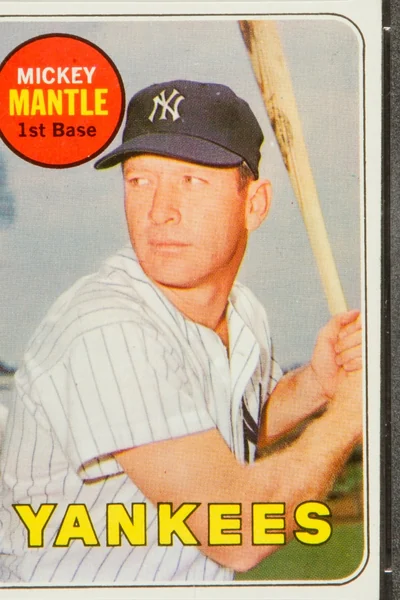
The card came later that summer. Topps issued 664 cards in 1969 across seven series, the largest set anyone had made to that point, at the standard 2 1/2 by 3 1/2 inches. The design is the plainest of the decade: a photograph filling the card, the team name in block capitals across the bottom with nothing behind it, and a colored circle in an upper corner holding the player’s name and position. On 500 the circle reads first base, which is where he had played in 1968 and where nobody thinks of him.
On 500 the circle reads first base, which is where nobody thinks of him.
The number is not an accident. Topps kept the round hundreds for the names it wanted a boy to pull, and 500 went to Mantle in a set that also carried the first cards of Reggie Jackson and Rollie Fingers. The front treats him as an active New York first baseman, which by the time the fifth series shipped he had not been for months. The back settles it in a single sentence noting the March 1 announcement, and above that sentence sit all eighteen seasons, complete, with nothing to add the following spring.
Card 500 falls in that fifth series, numbers 416 through 512, and the series produced the one variation collectors follow. On 23 of its cards the player’s name — sometimes the position with it — printed in white instead of the usual yellow. The explanation generally offered is an ink problem partway through the run rather than anything intended. Whatever the cause, the white-lettered cards came off the press in far smaller numbers than the yellow, and three of the 23 are Hall of Famers: Willie McCovey at 440, Gaylord Perry at 485, and this one.
The white letters read as cleaner and more deliberate than the yellow, which is part of why people want them, and is entirely an accident. The card itself is late enough to be competently made and early enough to have been cut and stacked without much care. The white border takes a corner knock from any handling and never hides it, and the centering drifts the way it does across the whole set. It is a plain photograph of a man in a Yankees cap, with a finished career on the back and no room left for another line.