On May 30, 1956, in the opening game of a Memorial Day doubleheader, Mantle turned on a 1-0 pitch from Pedro Ramos of the Washington Senators and drove it into the facade in right field at Yankee Stadium, roughly 18 inches below the top of it. The ball struck and fell back into the park. He said afterward that it was the best he had ever hit a ball left-handed, and he went on saying it for the rest of his life. He was twenty-four. The season was five weeks old.
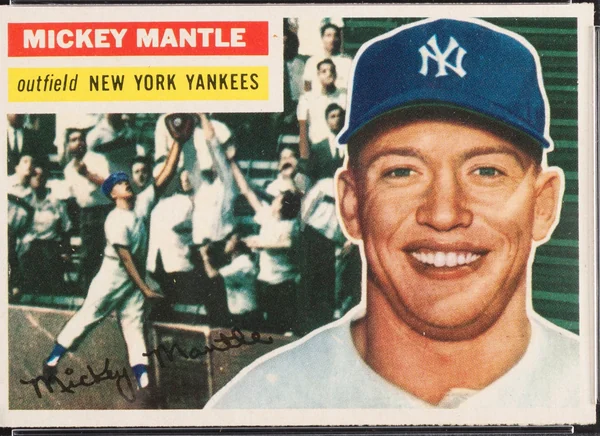
The card was already printed. Topps issued 340 numbered cards in 1956 at 2 5/8 by 3 3/4 inches, the last year it made them that large; in 1957 the format shrank to 2 1/2 by 3 1/2 and has stayed there ever since. Every card in the set is horizontal, which was the year’s whole idea: a portrait head to one side and, filling the rest of the card behind it, an action scene of the same man playing, worked up as artwork rather than printed from a photograph. The name and team sit at upper left, with a facsimile signature down in a corner.
A portrait head to one side and, filling the rest of the card behind it, the same man playing.
Cards 1 through 180 exist with two different backs, one on gray stock and one on white, and the split runs in both directions. Through the first hundred the white back is the ordinary one and gray is harder to find; from 101 to 180, where Mantle sits at 135, it reverses and the white back becomes much the scarcer of the two. No one has produced a satisfying explanation. It looks like what it probably was — Topps working through whatever cardboard was on hand between press runs. The reverse itself carries his figures and three small cartoons.
What makes 135 the one is a piece of timing it could not have planned. It was a second-series card, out early in the summer, while the season it belongs to was still being played. Mantle finished 1956 batting .353 with 52 home runs and 130 runs batted in, leading both leagues in all three, the only switch-hitter ever to do it. He led in runs with 132, took the MVP award unanimously, and in October, in the fifth inning of Don Larsen’s perfect game, ran down a Gil Hodges drive to left-center that he called the best catch he ever made.
It was also a homecoming. Bowman had held him exclusively through 1954 and 1955, so Topps had no Mantle at all for two years, and 1956 is the set where he comes back, alongside Bob Feller and Whitey Ford. As an object it is fragile in the ordinary ways of its decade. The sheets were trimmed carelessly and the edges show it. And the centering drifts on both axes at once, top to bottom as well as side to side, which a card built wide makes very easy to see.