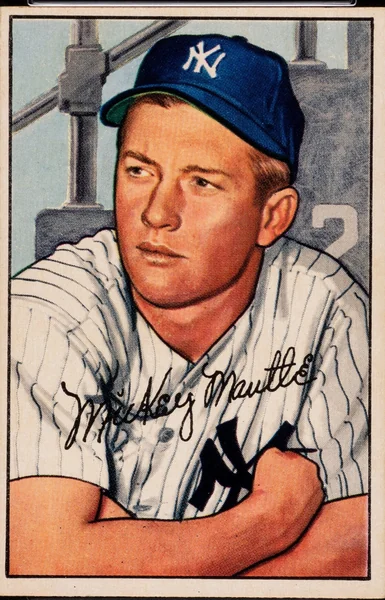
On October 5, 1951, in the fifth inning of the second game of the World Series, a fly ball went up into right-center at Yankee Stadium. Mickey Mantle, nineteen years old and playing right field beside Joe DiMaggio, went after it. His cleat caught a metal drainage cover set into the outfield grass, the knee turned, and he went down; DiMaggio called him off and made the catch. He was carried out of his first World Series and spent the winter on a knee that never afterward belonged entirely to him. The card here was painted and printed the following spring, while that was still the most discussed joint in baseball.
It is a small object. The 1952 Bowman set runs to 252 cards at 2 1/16 by 3 1/8 inches, each one a full-color hand-painted reproduction of a black-and-white photograph inside a plain white border. The year’s design change was in how a player got named: 1951’s black text box is gone, and in its place the facsimile signature runs straight across the picture. So the front of #101 carries Mickey Mantle in a copy of his own hand, laid over his own shoulder — a card signed, after a fashion, in the spring he turned twenty.
His name across his own shoulder, in a copy of his own hand, in the spring he turned twenty.
Two Mantles went into packs that summer, and the other one is the reason anybody has to explain this one. Topps built a 407-card set that year and put Mantle at #311, in the late series that shipped in the fall. Bowman put him at 101 of 252, in the ordinary run, on shelves from the start of the season. Bowman was the established company and had Stan Musial and Ralph Kiner, whom Topps missed entirely. What Topps had was a bigger card — more than half an inch taller and wider — and a newer idea of what a card was for. Within four years it had bought Bowman outright.
That is the whole of this card’s position, and it is worth stating without apology: it has never been the 311, and it does not try to be. Same player, same season, the same weeks on the same counters. One of them became the object the hobby organized itself around; the other stayed what it had always been, a well-made painting of a twenty-year-old outfielder who could not yet run properly.
What goes wrong with it goes wrong quietly. The white borders take a mark from any handling and show it. The centering wanders across the whole set, on this card as much as any. And the backs sat against the gum in one-cent packs, so wax staining is common enough that a clean reverse is a small find of its own. The card is little, which cuts both ways: it survived in pockets that would have bent a Topps, and every nick it did take reads larger on it than the same nick would there.